Updated October 2026
Lane Splitting Laws by State (2026): Where Is It Legal?
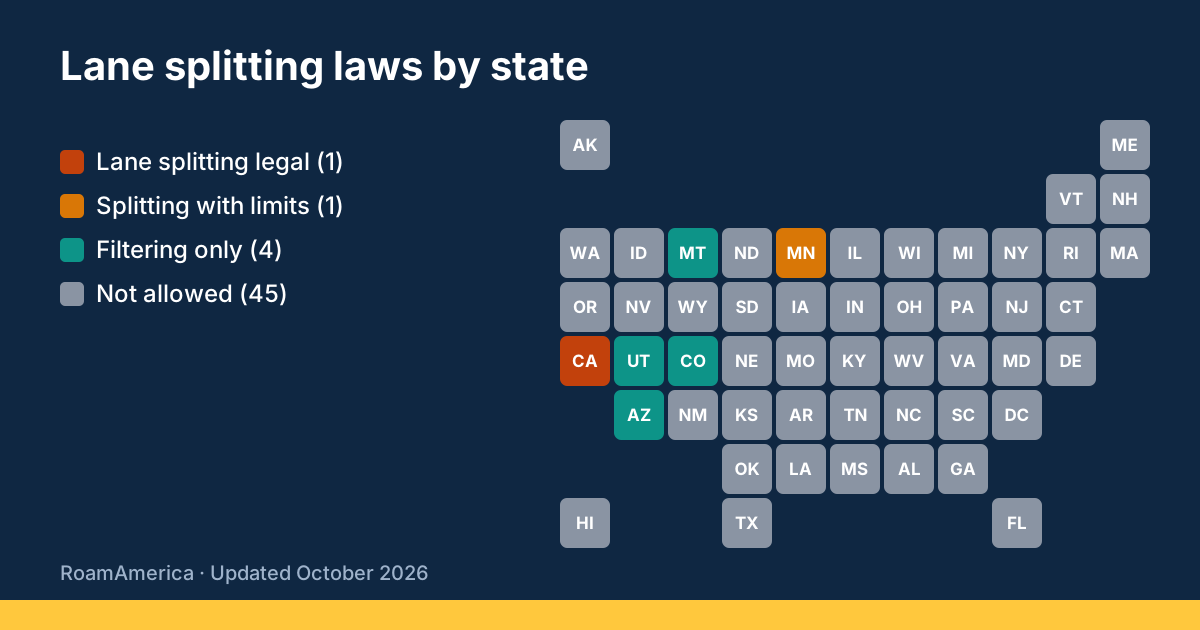
California is the only state where lane splitting is fully legal. Minnesota allows it with speed limits, and 4 states (Arizona, Colorado, Montana and Utah) allow lane filtering between stopped vehicles. Everywhere else, riding between lanes is not permitted.
Tap any state on the map for lane splitting laws in that state, or use the table to rank them.
This guide to lane splitting laws covers all 50 states and DC, with a map, a sortable table and a page for each state.
Lane splitting laws: all states
| State | Status | Since |
|---|---|---|
| Alabama | Not allowed | — |
| Alaska | Not allowed | — |
| Arizona | Filtering only | 2022 |
| Arkansas | Not allowed | — |
| California | Lane splitting legal | 2017 |
| Colorado | Filtering only | 2024 |
| Connecticut | Not allowed | — |
| Delaware | Not allowed | — |
| District of Columbia | Not allowed | — |
| Florida | Not allowed | — |
| Georgia | Not allowed | — |
| Hawaii | Not allowed | — |
| Idaho | Not allowed | — |
| Illinois | Not allowed | — |
| Indiana | Not allowed | — |
| Iowa | Not allowed | — |
| Kansas | Not allowed | — |
| Kentucky | Not allowed | — |
| Louisiana | Not allowed | — |
| Maine | Not allowed | — |
| Maryland | Not allowed | — |
| Massachusetts | Not allowed | — |
| Michigan | Not allowed | — |
| Minnesota | Splitting with limits | 2025 |
| Mississippi | Not allowed | — |
| Missouri | Not allowed | — |
| Montana | Filtering only | 2021 |
| Nebraska | Not allowed | — |
| Nevada | Not allowed | — |
| New Hampshire | Not allowed | — |
| New Jersey | Not allowed | — |
| New Mexico | Not allowed | — |
| New York | Not allowed | — |
| North Carolina | Not allowed | — |
| North Dakota | Not allowed | — |
| Ohio | Not allowed | — |
| Oklahoma | Not allowed | — |
| Oregon | Not allowed | — |
| Pennsylvania | Not allowed | — |
| Rhode Island | Not allowed | — |
| South Carolina | Not allowed | — |
| South Dakota | Not allowed | — |
| Tennessee | Not allowed | — |
| Texas | Not allowed | — |
| Utah | Filtering only | 2019 |
| Vermont | Not allowed | — |
| Virginia | Not allowed | — |
| Washington | Not allowed | — |
| West Virginia | Not allowed | — |
| Wisconsin | Not allowed | — |
| Wyoming | Not allowed | — |
Lane splitting vs. lane filtering
Lane splitting means riding between two lanes of moving traffic. Lane filtering means moving between stopped or very slow cars, generally to get to the front at a red light. Filtering laws are stricter: they set a maximum speed for the rider (15 or 20 mph) and often only apply on slower roads.
Is it safe?
A UC Berkeley study of California crashes found that lane splitting in slow traffic was relatively safe when riders traveled no more than about 15 mph faster than surrounding cars, and that splitting riders were less likely to be rear-ended. The risk rises fast at higher speed differences.
Regional patterns in lane splitting laws
By census region, lane splitting laws break down this way:
The table above lists lane splitting laws with a link to each state guide.
- Midwest: 1 splitting with limits, 11 not permitted.
- Northeast: 9 not permitted.
- South: 17 not permitted.
- West: 1 lane splitting legal, 4 filtering only, 8 not permitted.
The more permissive and stricter states for lane splitting laws
The more permissive states are California (Lane splitting legal), Minnesota (Splitting with limits), Arizona (Filtering only) and Colorado (Filtering only).
The stricter states you find Wyoming (Not allowed), Wisconsin (Not allowed), West Virginia (Not allowed) and Washington (Not permitted).
Every state page explains lane splitting laws in depth, with neighbors and local tips.
What changed lately in lane splitting laws
- Jul 2025 — Minnesota: Lane splitting became legal at up to 25 mph.
Questions about lane splitting laws
Which states allow lane splitting?
California fully allows lane splitting, and Minnesota allows it at up to 25 mph. Arizona, Colorado, Montana and Utah allow lane filtering only.
Is lane splitting legal in Texas or Florida?
No. Neither Texas nor Florida allows lane splitting or lane filtering.
Can I get a ticket for lane splitting?
Yes. In states where it is not permitted, motorcyclists can be cited for improper passing or an unsafe lane change.
Where can I check lane splitting laws for my state?
Pick your state from the table or map; each state page links to the agencies and indicates the review date.
How fast do lane splitting laws change?
Most updates take effect on January 1 or July 1 after a legislative session; we review the data at least twice a year and show the date on each page.
More rules by state
- Speed Limits by State (2026): Highest Posted Limits
- Cell Phone Driving Laws by State (2026): Hands-Free and Texting
- Driving Age by State (2026): Permit and License Ages
- Minimum Car Insurance Requirements by State (2026)
- Car Sales Tax by State (2026) + Calculator
- Vehicle Inspection and Emissions Testing by State (2026)
- Moving to a New State? License and Registration Deadlines (2026)
- Motorcycle Helmet Laws by State (2026)
- Compare neighboring states