State guide · Updated October 2026
Vermont Driving Laws (2026): A Complete Guide
Vermont sits in the Northeast region, with Montpelier as its capital and Burlington and South Burlington as its biggest cities. This guide collects the Vermont driving laws that matter most, covering speed limits and phone use to coverage, taxes, inspections and riding.
Every section below explains one rule in full, with the facts, the numbers and how it compares nationally, and the figures were last checked October 25, 2026.
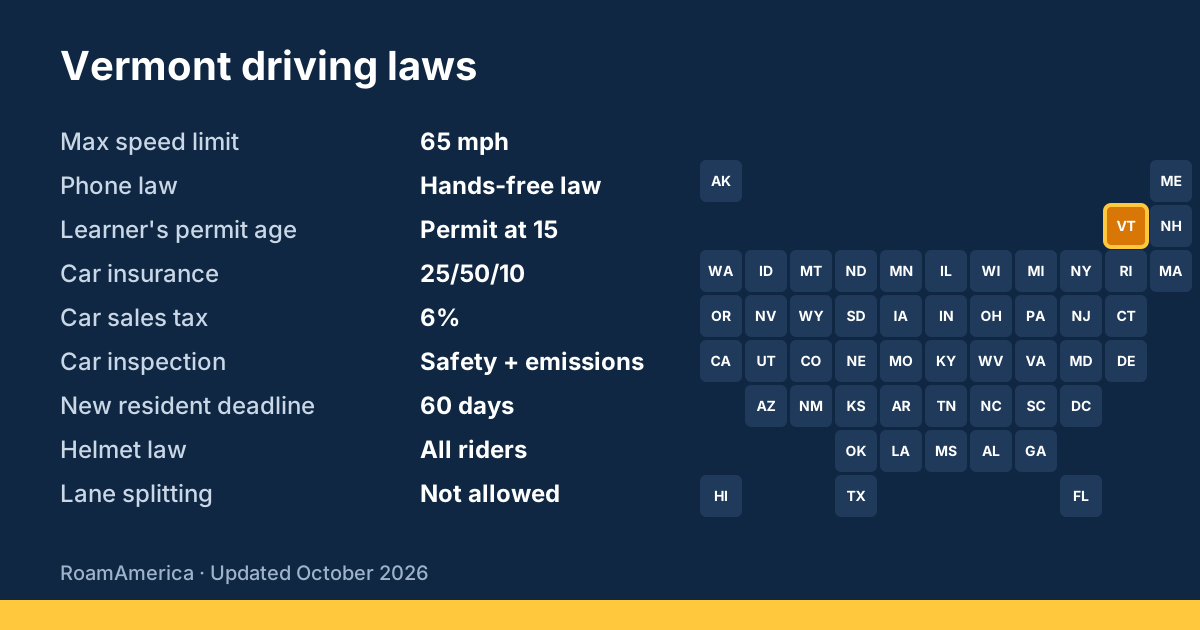
Vermont driving laws: speed limits
The highest speed limit in Vermont is 65 mph. Rural interstates reach up to 65 mph and urban interstates at up to 55 mph.
| Vermont: Maximum posted speed | 65 mph |
|---|---|
| Interstates outside cities | 65 mph |
| Urban interstates | 55 mph |
On major roads such as I-89 and I-91, signs are frequently below 65 mph, especially through Burlington and in work zones.
Motorists also need to keep a speed reasonable for rain, fog and traffic, even below the posted number.
Bottom line, under Vermont driving laws: max speed limit, 65 mph.
Vermont driving laws: cell phone and texting law
Only hands-free. Vermont enforces a hands-free law: anyone driving are not allowed to hold a phone to talk, text or browse on the road. Bluetooth calls and mounted navigation remain legal.
| Vermont: Hand-held phone use (all motorists) | Banned |
|---|---|
| Texting behind the wheel | Banned |
| Teen phone ban | Drivers under 18 |
Under the Vermont driving laws, a phone in a mount, voice commands and one touch to pick up a call or begin a route are permitted; having it in your hand at a stoplight is the offense.
New drivers face stricter laws: in Vermont, motorists under 18 cannot touch a phone in any way, even hands-free.
Bottom line, under Vermont driving laws: phone law, hands-free law.
Vermont driving laws: driving age and teen licenses
Young motorists in Vermont may apply for a learner's permit at 15 and an intermediate (provisional) license at 16, which still restricts night driving and passengers.
| Vermont: Earliest permit | Age 15 |
|---|---|
| Provisional license | Age 16 |
| Supervised driving hours | 40 (10 at night) |
| Unrestricted license | After 6 months licensed or at 18, whichever comes first |
To qualify for the road test, permit holders in Vermont log 40 hours (10 at night) of supervised driving.
At a glance, under Vermont driving laws: learner's permit age, permit at 15.
Vermont driving laws: minimum car insurance
Vermont requires motorists to carry at least 25/50/10 in liability coverage: $25,000 for injuries to one person, $50,000 for all injuries in one crash and $10,000 for property damage. You also need uninsured motorist (UM) coverage and underinsured motorist (UIM) coverage.
| Vermont: Injury limit per person | $25,000 |
|---|---|
| Bodily injury per accident | $50,000 |
| Property damage | $10,000 |
| Other required coverage | UM, UIM |
| Claims system | At-fault |
| Coverage required by law | Yes |
Vermont follows the at-fault system, so the at-fault driver pays for the other drivers' injuries and damage via their liability insurance.
Required on top of liability in Vermont: uninsured motorist (UM) coverage and underinsured motorist (UIM) coverage.
A minimum policy often falls short in a serious crash: medical bills plus a replacement car can pass $50,000 fast.
Many agents suggest at least 100/300/100, since costs beyond the policy can be taken from your savings.
Bottom line, under Vermont driving laws: car insurance, 25/50/10.
Vermont driving laws: car sales tax
Vermont charges a 6% state purchase and use tax on vehicles you buy. There are no additional local taxes.
| Vermont: State rate | 6% (purchase and use tax) |
|---|---|
| Local add-ons | No |
| Trade-in deducted | Yes |
| Tax on a $30,000 purchase | $1,800 |
- A $22,500 car in Vermont: roughly $1,350 in state tax
- A $38,750 car in Vermont: roughly $2,325 in state tax
- A $55,000 car in Vermont: roughly $3,300 in state tax
A trade-in cuts the Vermont driving laws: trading in a $5,000 car on a $30,000 purchase means paying about $1,500 rather than $1,800.
In short, under Vermont driving laws: car sales tax, 6%.
Vermont driving laws: vehicle inspection and emissions
Yes. Vermont requires an annual safety inspection and emissions testing statewide.
| Vermont: Mechanical inspection | Every year |
|---|---|
| Emissions testing | Statewide |
The annual inspection includes an on-board diagnostics (emissions) check.
The safety check in Vermont looks at brakes, lights, tires, steering, glass and horn once a year.
Emissions tests on newer vehicles read the on-board computer through the OBD port; a lit check-engine light generally means a failure.
In short, under Vermont driving laws: car inspection, safety + emissions.
Vermont driving laws: license and registration deadlines for new residents
After moving to Vermont, you have 60 days to obtain a Vermont driver's license, and 60 days to register your car.
| Vermont: License deadline | 60 days |
|---|---|
| Register your car | 60 days |
| Insurance minimum | 25/50/10 |
| Inspection law | Safety + emissions |
Step-by-step list for Vermont driving laws
- Apply for a Vermont driver's license: 60 days. Bring an ID document, your Social Security number and two proofs of address when you visit the Vermont DMV (REAL ID laws).
- Buy car insurance that meets the minimum: Vermont sets a floor of 25/50/10. Coverage is typically needed before registration.
- Inspection: Yes. Vermont requires an annual safety inspection and emissions testing statewide.
- Register and title your car: 60 days at the Vermont DMV.
The clock typically starts when you start work, sign a lease or register kids for school in Vermont, not on the day the moving truck shows up.
At a glance, under Vermont driving laws: new resident deadline, 60 days.
Vermont driving laws: motorcycle helmet law
Yes. Vermont has a universal helmet law: every motorcycle rider and passenger need to wear a DOT-certified helmet, whatever their age. Local ordinances in Burlington or Montpelier cannot relax it; it applies statewide.
| Vermont: Who must wear a helmet | All riders and passengers |
|---|---|
| Law type | Universal |
| Adults may ride without a helmet | No |
Under the Vermont driving laws, operators and passengers of each age must wear a helmet on each motorcycle, including mopeds that require an endorsement.
Federal safety data show that helmets cut 37% of rider deaths in crashes, and around 41% for passengers.
A compliant helmet indicates the DOT symbol at the rear; thin novelty shells that lack it do not count.
Bottom line, under Vermont driving laws: helmet law, all motorcyclists.
Vermont driving laws: lane splitting
No. Riding between lanes are not allowed in Vermont. Each motorcycle gets its own full lane, and riders are not allowed to pass between vehicles or split traffic.
| Vermont: Lane splitting (moving traffic) | Not legal |
|---|---|
| Filtering at a stop | Not legal |
| Law dates from | — |
Because no statute permits it, Vermont driving laws is cited as improper passing, and a crash during a split can count against the rider in an injury claim.
In short, under Vermont driving laws: lane splitting, not allowed.
Where the Vermont driving laws stand out
- 65 mph (max speed limit), in the slower group of 10 nationwide
Getting around Vermont
Most long trips use I-89, I-91 and US-7, which tie together Burlington, South Burlington and Montpelier. Each of these routes falls under Vermont driving laws.
You get a license from the Vermont DMV, and plates and titles go through the Vermont DMV.
Every law on this page applies in every county, whether in Burlington or in rural counties.
Next door
- Massachusetts: car sales tax 6.25% (vs. 6%); car insurance of 25/50/30 instead of 25/50/10
- New Hampshire: max speed limit 70 mph (vs. 65 mph); None for car sales tax, against 6%; 25/50/25 for car insurance, against 25/50/10
- New York: 4% for car sales tax, against 6%
Questions about the Vermont driving laws
Do the Vermont driving laws change for trucks?
Most roads in Vermont use the same number for passenger vehicles and big rigs; stay alert to truck-only limits.
Will police pull over motorists only for violating the Vermont driving laws?
Yes. In Vermont it is generally primary enforcement, so an officer can stop you for it alone.
May a 15-year-old drive unsupervised under the Vermont driving laws laws?
No. Driving without an adult is permitted once you hold the provisional license at 16 in Vermont.
What happens if I drive without Vermont driving laws?
Driving uninsured in Vermont may bring fines, a suspended license and registration, and personal liability for crash costs.
Is the Vermont driving laws charged on used cars?
Yes. A used car is taxed the same way, and sales between individuals can be valued at a minimum or a standard value.
Is a Vermont driving laws required to sell a car?
The car must have a current inspection when it is registered in Vermont.
Does an adult need to follow the Vermont driving laws?
Yes. All motorcyclists and passengers in Vermont needs a helmet.
Is moving up at a light part of Vermont driving laws?
No. Moving between stopped cars at a light is banned in Vermont as well.