State guide · Updated October 2026
Texas Driving Laws (2026): Speed Limits, Insurance and More
Texas sits in the South census region, with Austin as the capital and Houston and San Antonio as its biggest cities. This page gathers the Texas driving laws that matter most, from speed and phones to insurance, car tax and motorcycles.
Every section below covers one rule in detail, with the facts, the numbers and how it compares nationally, and the figures were last checked October 25, 2026.
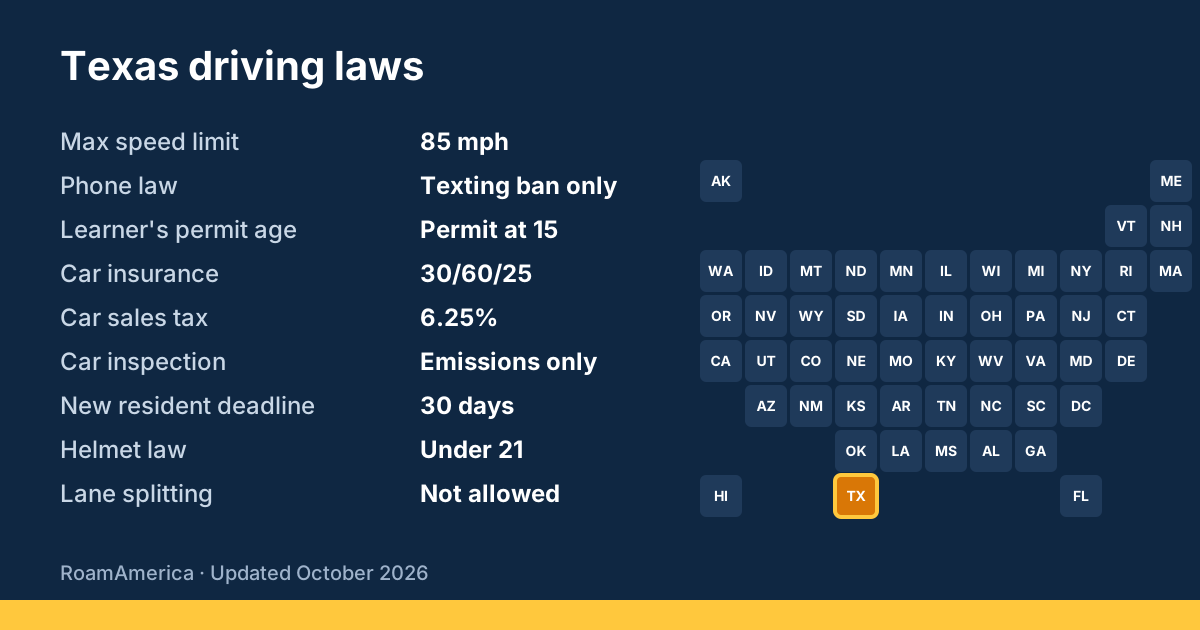
Texas driving laws: speed limits
The highest speed limit in Texas is 85 mph. Interstates carry limits of up to 75 mph in both rural and urban areas.
| Texas: Highest posted limit | 85 mph |
|---|---|
| Rural interstates | 75 mph |
| City freeways | 75 mph |
85 mph is posted on part of the SH 130 toll road close to Austin, the highest limit in the country; 80 mph applies on some rural stretches of I-10 and I-20.
On busy roads such as I-35 and I-10, posted limits are frequently lower than 85 mph, especially through Houston and in work zones.
Drivers must also keep a speed that is safe for weather and traffic, even under the limit.
In short, under Texas driving laws: max speed limit, 85 mph.
Texas driving laws: cell phone and texting law
Yes for calls, no for texting. Texas prohibits texting while driving for all drivers, but adult motorists can still use a hand-held phone for calls.
| Texas: Holding a phone while driving | Allowed |
|---|---|
| Texting behind the wheel | Banned |
| Teen phone ban | Drivers under 18 |
Texting is banned statewide; hand-held phone use is banned in school zones and in cities with their own hands-free ordinances.
Texting laws apply to each driver in Texas, but talking on a hand-held phone for a call is not banned statewide for adult drivers.
Rules are tighter for teenagers: in Texas, drivers under 18 cannot touch a phone while driving, hands-free included.
Bottom line, under Texas driving laws: phone law, texting ban only.
Texas driving laws: driving age and teen licenses
In Texas, teenagers can apply for a learner's permit at 15 and a provisional license at 16, which still restricts night driving and passengers.
| Texas: Earliest permit | Age 15 |
|---|---|
| Provisional license | Age 16 |
| Practice hours | 30 (10 at night) |
| All limits lifted | Age 18 |
Prior to the road test, teens in Texas log 30 hours (10 at night) of supervised driving.
Bottom line, under Texas driving laws: learner's permit age, permit at 15.
Texas driving laws: minimum car insurance
Texas requires at least 30/60/25 in liability coverage: $30,000 for one injured person, $60,000 for all injuries in one crash and $25,000 for property damage.
| Texas: Injury limit per person | $30,000 |
|---|---|
| Per-accident injury coverage | $60,000 |
| Damage to property | $25,000 |
| Extra required coverage | None |
| Fault system | At-fault |
| Coverage mandatory by law | Yes |
Texas uses fault-based claims, so whoever causes a crash answers for the other people's injuries and damage through liability coverage.
The legal minimum frequently falls short in a serious crash: medical bills plus a replacement car can top $60,000 fast.
Many agents suggest at least 100/300/100, as costs beyond the policy can be claimed from you personally.
In short, under Texas driving laws: car insurance, 30/60/25.
Texas driving laws: car sales tax
Texas charges a 6.25% state motor vehicle sales tax on cars you buy. There are no additional local taxes.
| Texas: State-level rate | 6.25% (motor vehicle sales tax) |
|---|---|
| Local taxes added | No |
| Trade-in credit | Yes |
| State tax on a $30,000 car | $1,875 |
Private-party sales are taxed on the price or 80% of the vehicle's standard presumptive value, whichever is higher.
- A $22,300 car in Texas: roughly $1,394 in state tax
- A $38,450 car in Texas: roughly $2,403 in state tax
- A $55,000 car in Texas: around $3,438 in state tax
A trade-in reduces the Texas driving laws: with $5,000 in trade on a $30,000 car, you owe around $1,563 rather than $1,875.
In short, under Texas driving laws: car sales tax, 6.25%.
Texas driving laws: car inspection and emissions
Only an emissions test. Texas has no regular safety inspection, but requires emissions testing in 17 counties, including the Houston, Dallas–Fort Worth, Austin and El Paso areas.
| Texas: Safety check | Not mandatory |
|---|---|
| Emissions testing | Some areas: 17 counties, including the Houston, Dallas–Fort Worth, Austin and El Paso areas |
Safety inspections for non-commercial vehicles ended January 1, 2025, and were replaced by a $7.50 fee at registration. Emissions tests continue in the listed counties.
With no regular safety check in Texas, maintaining brakes and tires in shape is the owner's job.
Emissions tests on newer cars read the on-board computer, which takes a few minutes; a lit check-engine light generally means a failure.
At a glance, under Texas driving laws: car inspection, emissions only.
Texas driving laws: license and registration deadlines for new residents
After moving to Texas, you have 90 days to obtain a Texas driver's license, and 30 days to register your car.
| Texas: License deadline | 90 days |
|---|---|
| Plate deadline | 30 days |
| Required insurance | 30/60/25 |
| Vehicle check | Emissions only |
Step-by-step list for Texas driving laws
- Apply for a Texas driver's license: 90 days. Bring proof of identity, your SSN and two documents with your new address when you visit the Texas Department of Public Safety (DPS); REAL ID rules apply.
- Set up car insurance at or above the minimum: Texas sets a floor of 30/60/25. Coverage is typically mandatory before registration.
- Vehicle check: Only an emissions test. Texas skips safety inspections, but does require emissions testing in 17 counties, including the Houston, Dallas–Fort Worth, Austin and El Paso areas.
- Title and register the car: 30 days at the county tax assessor-collector.
The clock typically begins when you take a job, buy a house or enroll children in school in Texas, not on the day the boxes arrive.
In short, under Texas driving laws: new resident deadline, 30 days.
Texas driving laws: motorcycle helmet law
Only if you are under 21. In Texas, motorcyclists 20 and younger must wear a helmet; motorcyclists 21 and older can legally go without one. Local ordinances in Houston or Austin do not change it; it applies statewide.
| Texas: Helmet required for | Riders 20 and younger |
|---|---|
| Kind of law | Partial (age-based) |
| Adult riders exempt | Yes, with conditions |
Riders 20 and younger are required to wear a helmet under the Texas driving laws; from age 21 the choice is the rider's.
Riders 21 and older may ride without a helmet if they have completed a motorcycle safety course or carry health insurance.
Crash research suggests that helmets prevent about over a third of rider deaths, and around 41% of passenger deaths.
A legal helmet carries the DOT symbol at the rear; novelty helmets without it do not count.
Bottom line, under Texas driving laws: helmet law, under 21.
Texas driving laws: lane splitting
No. Splitting and filtering are illegal in Texas. Each motorcycle gets its own full lane, and riders cannot squeeze between cars or ride between lanes of traffic.
| Texas: Riding between moving lanes | Not legal |
|---|---|
| Lane filtering (stopped traffic) | Not legal |
| Law dates from | — |
Without a law that allows it, Texas driving laws is treated as an illegal pass or an unsafe lane change, and a collision while doing it can undercut the rider.
In short, under Texas driving laws: lane splitting, not permitted.
Where the Texas driving laws stand out
- 85 mph (max speed limit), the faster in the country
Getting around Texas
Most long trips use I-35, I-10 and I-45, connecting Houston, San Antonio and Austin, the capital. Every one of these roads is covered by Texas driving laws.
You obtain a license from the Texas Department of Public Safety (DPS), and plates and titles come from the county tax assessor-collector.
All of the Texas driving laws above apply in every county, from Houston to small towns.
Across the border
- Arkansas: max speed limit of 75 mph instead of 85 mph; 6.5% for car sales tax, against 6.25%; car insurance of 25/50/25 instead of 30/60/25
- Louisiana: max speed limit 75 mph (vs. 85 mph); car sales tax of 5% instead of 6.25%; 15/30/25 for car insurance, against 30/60/25
- New Mexico: max speed limit 75 mph (vs. 85 mph); car sales tax of 4% instead of 6.25%; 25/50/10 for car insurance, against 30/60/25
- Oklahoma: max speed limit of 80 mph instead of 85 mph; car sales tax 4.5% (vs. 6.25%); car insurance of 25/50/25 instead of 30/60/25
Questions about the Texas driving laws
Do the Texas driving laws differ for trucks?
Nearly all roads in Texas use the same number for cars and trucks; stay alert to signs posted just for trucks.
Can an officer stop you only for breaking the Texas driving laws?
Yes. In Texas it is generally a primary offense, so an officer can stop you for it alone.
May a 15-year-old drive unsupervised under the Texas driving laws rules?
No. Solo driving begins once you hold the provisional license at 16 in Texas.
What if I drive without Texas driving laws?
Driving uninsured in Texas can bring fines, suspension of your license and plates, and personal liability for the damage you cause.
Is the Texas driving laws charged on used cars?
Yes. Used cars are taxed too, and private sales can be valued at a minimum or book value.
Is a Texas driving laws needed to sell a car?
Usually not in Texas, but a pre-purchase check is smart.
Must adult motorcyclists obey the Texas driving laws?
No. Only motorcyclists 20 and younger must wear one in Texas; riders 21 and older can ride without a helmet if they have completed a motorcycle safety course or carry health insurance.
Is filtering at a stoplight part of Texas driving laws?
No. Squeezing between stopped vehicles at a light is banned in Texas as well.
Travel ideas in Texas
- Place to visitThe Alamo“Remember the Alamo!” Stand where a 13-day siege changed the history of Texas.
- Place to visitBig Bend National ParkDesert, mountains and river canyons on the Mexican border, under some of the darkest skies in North America.
- RV road tripRoute 66The Mother Road turns 100 in 2026: neon motels, diners and 2,448 miles of Americana.