State guide · Updated October 2026
District of Columbia Driving Laws (2026): Speed, Phone, Insurance, Tax
the District of Columbia sits in the South region, with Washington as its capital and Washington and Georgetown as its biggest cities. This guide collects the District of Columbia driving laws that matter most, covering speed and phones through insurance, car tax and motorcycles.
Each section below answers one question in detail, with the facts, the numbers and how it compares nationally, and the figures were last checked October 25, 2026 for District of Columbia.
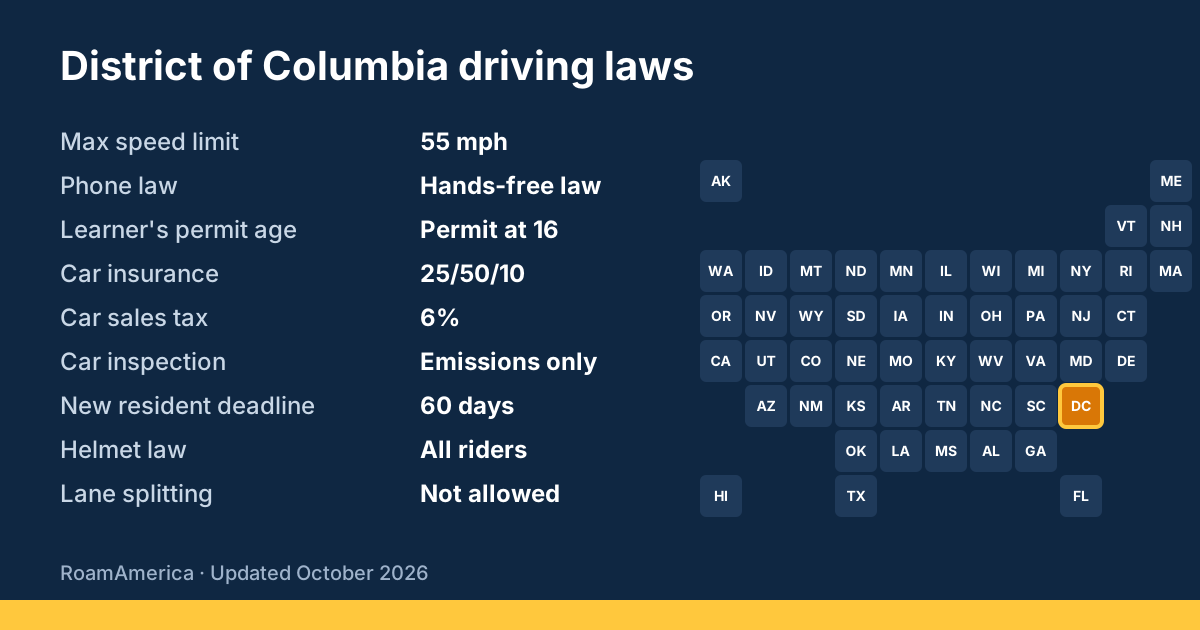
District of Columbia driving laws: speed limits
The maximum speed limit in the District of Columbia is 55 mph.
| the District of Columbia: Highest posted limit | 55 mph |
|---|---|
| Rural interstates | No rural interstates |
| City freeways | 55 mph |
Most DC streets are 25 mph or lower.
On major roads such as I-395 and I-295, signs are frequently below 55 mph, especially around Washington and in work zones.
Every driver must also hold a speed that suits the conditions, even below the posted number, and officers can write a ticket for that alone.
At a glance, under District of Columbia driving laws: max speed limit, 55 mph.
District of Columbia driving laws: cell phone and texting law
Only hands-free. the District of Columbia has a hands-free law: anyone driving cannot hold a phone to make calls or send messages on the road. Voice calls through the car and a mounted map are fine.
| the District of Columbia: Hand-held calls | Banned |
|---|---|
| Texting while driving (all drivers) | Banned |
| Phone ban for new motorists | Permit holders and drivers under 18 |
Under the District of Columbia driving laws, a mounted phone, voice commands and a single tap to take a call or start navigation are permitted; picking it up, even at a red light, is not.
Rules are tighter for teenagers: in the District of Columbia, permit holders and motorists under 18 cannot touch a phone while driving, hands-free included.
At a glance, under District of Columbia driving laws: phone law, hands-free law.
District of Columbia driving laws: driving age and teen licenses
Young motorists in the District of Columbia can obtain a learner's permit at 16 and an intermediate (provisional) license at 16, with night and passenger limits after that.
| the District of Columbia: Permit age | Age 16 |
|---|---|
| Provisional license | Age 16 |
| Hours with an adult | 40, plus 10 at night |
| Full privileges | After 6 months licensed or at 21, whichever comes first (minimum 18) |
To qualify for the road test, teenagers in the District of Columbia must log 40 hours, plus 10 at night of supervised driving.
Bottom line, under District of Columbia driving laws: learner's permit age, permit at 16.
District of Columbia driving laws: minimum car insurance
the District of Columbia requires drivers to carry at least 25/50/10 in liability insurance: $25,000 for injuries to one person, $50,000 for all injuries in one crash and $10,000 for property damage. You also need uninsured motorist (UM) coverage.
| the District of Columbia: Per-person injury coverage | $25,000 |
|---|---|
| Bodily injury per accident | $50,000 |
| Property damage limit | $10,000 |
| Other required coverage | UM |
| Claims system | At-fault |
| Coverage mandatory by law | Yes |
the District of Columbia uses fault-based claims, so the at-fault driver pays for the other parties' injuries and damage through liability coverage.
Required on top of liability in the District of Columbia: uninsured motorist (UM) coverage.
A minimum policy seldom pays for a serious crash, since hospital bills and a new car can pass $50,000 in one crash.
Advisers often recommend limits like 100/300/100, as costs beyond the policy can be collected from you directly.
At a glance, under District of Columbia driving laws: car insurance, 25/50/10.
District of Columbia driving laws: car sales tax
the District of Columbia applies a 6% state excise tax on vehicle purchases. There are no additional local taxes.
| the District of Columbia: State-level rate | 6% (excise tax) |
|---|---|
| Local taxes added | No |
| Trade-in deducted | No |
| State tax on a $30,000 car | $1,800 |
Since February 2025, DC's one-time titling excise tax varies with the vehicle's weight and city fuel economy, so efficient vehicles pay much less than heavy, thirsty ones. The 6% used here is only an estimate; verify the DC DMV excise tax table for your car.
- A $18,800 car in the District of Columbia: roughly $1,128 in state tax
- A $33,200 car in the District of Columbia: roughly $1,992 in state tax
- A $55,000 car in the District of Columbia: roughly $3,300 in state tax
the District of Columbia taxes the full price, so a trade-in does not lower the District of Columbia driving laws.
At a glance, under District of Columbia driving laws: car sales tax, 6%.
District of Columbia driving laws: car inspection and emissions
Only an emissions test. the District of Columbia skips safety inspections, but requires emissions testing statewide.
| the District of Columbia: Safety check | Not required |
|---|---|
| Smog check | Statewide |
Private vehicles need an emissions inspection every two years; safety inspections were dropped for most private vehicles.
Without periodic inspections in the District of Columbia, keeping brakes, lights and tires in good order is your responsibility.
Emissions tests on newer cars read the on-board computer, which takes a few minutes; a lit check-engine light generally means an automatic fail.
Bottom line, under District of Columbia driving laws: car inspection, emissions only.
District of Columbia driving laws: license and registration deadlines for new residents
After moving to the District of Columbia, you have 60 days to obtain a District of Columbia driver's license, and 60 days to register your car.
| the District of Columbia: New driver's license | 60 days |
|---|---|
| Vehicle registration | 60 days |
| Required insurance | 25/50/10 |
| Inspection | Emissions only |
You must convert to a DC driver's license before you can register a vehicle in DC.
Checklist for District of Columbia driving laws
- Apply for a District of Columbia driver's license: 60 days. Bring proof of identity, your SSN and two documents with your new address to the DC DMV; REAL ID rules apply.
- Set up car insurance that meets the minimum: the District of Columbia sets a floor of 25/50/10. Coverage is typically needed ahead of registration.
- Inspection: Only an emissions test. the District of Columbia has no regular safety inspection, but requires emissions testing statewide.
- Register and title your car: 60 days at the DC DMV.
The clock generally begins when you start work, sign a lease or register kids for school in the District of Columbia, not on the day the truck arrives.
In short, under District of Columbia driving laws: new resident deadline, 60 days.
District of Columbia driving laws: motorcycle helmet law
Yes. the District of Columbia has a universal helmet law: all motorcyclists and passengers has to wear a DOT-approved helmet, whatever their age. That holds on I-395 and I-295 as much as on local streets in Washington.
| the District of Columbia: Helmet required for | All motorcyclists and passengers |
|---|---|
| Type of law | Universal |
| Adults can ride without a helmet | No |
Under the District of Columbia driving laws, operators and passengers of each age must wear a helmet on each motorcycle, and on mopeds that need an endorsement.
NHTSA estimates that helmets reduce roughly 37% of rider deaths in crashes, and around 41% of passenger deaths.
Any helmet worn to meet the law indicates the DOT label on the back; thin novelty shells that lack it are not legal.
At a glance, under District of Columbia driving laws: helmet law, all riders.
District of Columbia driving laws: lane splitting
No. Lane splitting and lane filtering are not legal in the District of Columbia. Each motorcycle gets its own full lane, and motorcyclists cannot squeeze between vehicles or split traffic.
| the District of Columbia: Riding between moving lanes | Not legal |
|---|---|
| Lane filtering (stopped traffic) | Not legal |
| Law dates from | — |
With no law allowing it, District of Columbia driving laws counts as an illegal pass or an unsafe lane change, and a crash during a split may hurt the rider with insurers.
Bottom line, under District of Columbia driving laws: lane splitting, not permitted.
Where the District of Columbia driving laws stand out
- 55 mph (max speed limit), last in the nation (slower than every state)
- Learner's permit age: Permit at 16 — among the later 8 states
Getting around District of Columbia
Most long trips use I-395, I-295 and I-695, linking Washington, Georgetown and Washington. Each of these routes falls under District of Columbia driving laws.
Driver's licenses are issued by the DC DMV, and plates and titles come from the DC DMV.
Every law on this page applies across the state, whether in Washington or in rural counties.
Next door
- Maryland: max speed limit 70 mph (vs. 55 mph); car sales tax of 6.5% instead of 6%; car insurance of 30/60/15 instead of 25/50/10
- Virginia: max speed limit of 70 mph instead of 55 mph; car sales tax 4.15% (vs. 6%); car insurance 50/100/25 (vs. 25/50/10)
FAQ: the District of Columbia driving laws
Do the District of Columbia driving laws change for trucks?
The majority of roads in the District of Columbia post the same number for passenger vehicles and big rigs; stay alert to separate truck signs.
Can an officer stop a driver only for ignoring the District of Columbia driving laws?
Yes. In the District of Columbia it is generally primary enforcement, so an officer can stop you for it without any other reason.
Can a 15-year-old drive alone under the District of Columbia driving laws laws?
No. Driving alone is allowed after you receive the provisional license at 16 in the District of Columbia.
Can I drive without District of Columbia driving laws?
Skipping insurance in the District of Columbia may bring fines, suspension of your license and plates, and personal liability for the damage you cause.
Is the District of Columbia driving laws due on used vehicles?
Yes. Used cars are taxed too, and private sales may be valued at a minimum or book value.
Is a District of Columbia driving laws needed to sell a car?
Not by law in the District of Columbia, although a buyer can want one.
Do adults have to follow the District of Columbia driving laws?
Yes. All riders and passengers in the District of Columbia must wear a helmet.
Is filtering at red lights part of District of Columbia driving laws?
No. Squeezing between stopped vehicles at a light is not permitted in the District of Columbia as well.
Travel ideas in District of Columbia
- Place to visitNational Air and Space MuseumThe Wright Flyer, the Spirit of St. Louis and Apollo 11’s command module under one roof.
- Place to visitNational MallThree kilometers of monuments and museums at the heart of Washington, DC, nearly all of them free.
- Place to visitSmithsonian National Museum of Natural HistoryThe Hope Diamond, a hall of dinosaurs and a giant elephant, all free on the National Mall.
- Place to visitNational Gallery of ArtThe only Leonardo da Vinci painting in the Americas, free on the National Mall.