State guide · Updated October 2026
Colorado Driving Laws (2026): Speed, Phone, Insurance, Tax
Colorado belongs to the West region, with Denver as the capital and Denver and Colorado Springs among its largest cities. Here you will find the Colorado driving laws that matter most, covering speed and phones to insurance, car tax and motorcycles.
Every section below covers one law in detail, with key facts and the national picture with sources; data was reviewed October 25, 2026.
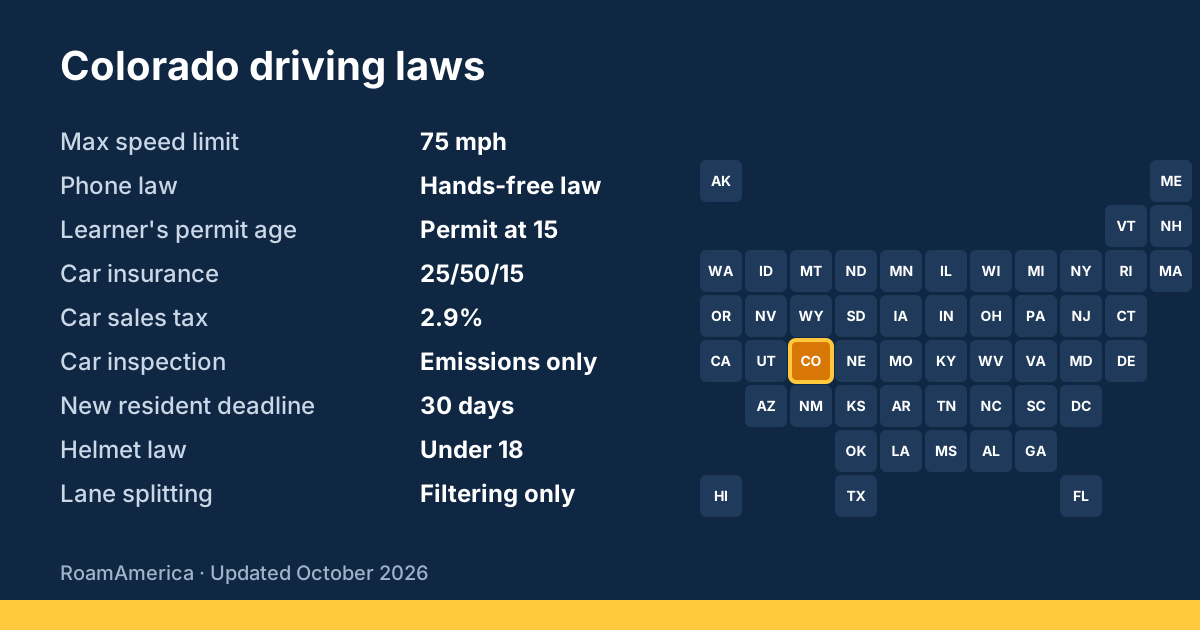
Colorado driving laws: speed limits
The maximum speed limit in Colorado is 75 mph. Rural interstates reach up to 75 mph and urban freeways at up to 65 mph.
| Colorado: Top posted speed | 75 mph |
|---|---|
| Rural freeways | 75 mph |
| Interstates in cities | 65 mph |
On busy roads such as I-25 and I-70, posted limits are frequently lower than 75 mph, especially through Denver and in work zones.
Drivers must also keep a speed that is safe for rain, fog and traffic, even under the limit, and officers may write a ticket for that alone.
In short, under Colorado driving laws: max speed limit, 75 mph.
Colorado driving laws: cell phone and texting law
Only hands-free. Colorado has a hands-free law: anyone driving cannot hold a phone to make calls or send messages behind the wheel. Voice calls through the car and a mounted map are fine.
| Colorado: Hand-held calls | Banned |
|---|---|
| Texting behind the wheel | Banned |
| Teen phone ban | No |
Colorado's hands-free law took effect January 1, 2025.
Under the Colorado driving laws, a dash-mounted phone, voice commands and a single tap to pick up a call or start navigation are permitted; holding the phone, even at a red light, is what gets ticketed.
At a glance, under Colorado driving laws: phone law, hands-free law.
Colorado driving laws: driving age and teen licenses
Teens in Colorado may obtain a learner's permit at 15 and a provisional (intermediate) license at 16, with night and passenger limits after that.
| Colorado: Learner's permit | Age 15 |
|---|---|
| Intermediate (provisional) license | Age 16 |
| Supervised driving hours | 50 (10 at night) |
| Unrestricted license | After 12 months licensed or at 18, whichever comes first (minimum 17) |
Prior to the road test, permit holders in Colorado log 50 hours (10 at night) of supervised driving.
In short, under Colorado driving laws: learner's permit age, permit at 15.
Colorado driving laws: minimum car insurance
Colorado requires motorists to carry at least 25/50/15 in liability insurance: $25,000 for injuries to one person, $50,000 for all injuries in one crash and $15,000 for property damage.
| Colorado: Injury limit per person | $25,000 |
|---|---|
| Per-accident injury coverage | $50,000 |
| Damage to property | $15,000 |
| Other required coverage | None |
| Claims system | At-fault |
| Must you insure | Yes |
Colorado uses fault-based claims, so whoever causes a crash is responsible for the other drivers' injuries and damage through liability coverage.
Bare-minimum coverage seldom pays for a serious crash: medical bills plus a replacement car can top $50,000 fast.
Consumer groups suggest limits like 100/300/100, since damages above your limits may be taken from your savings.
Bottom line, under Colorado driving laws: car insurance, 25/50/15.
Colorado driving laws: car sales tax
Colorado collects a 2.9% state sales tax on cars you buy, and local taxes can come on top.
| Colorado: Statewide rate | 2.9% (sales tax) |
|---|---|
| City or county tax | Yes, in some areas |
| Trade-in deducted | Yes |
| State tax on a $30,000 car | $870 |
The 2.9% state rate is low, but county, city and special district taxes often bring the total to 7% or more.
- A $18,500 car in Colorado: roughly $537 in state tax
- A $32,750 car in Colorado: about $950 in state tax
- A $55,000 car in Colorado: roughly $1,595 in state tax
A trade-in cuts the Colorado driving laws: a $30,000 car with a $5,000 trade-in owes about $725 rather than $870.
At a glance, under Colorado driving laws: car sales tax, 2.9%.
Colorado driving laws: car inspection and emissions
Only an emissions test. Colorado does not require periodic safety checks, but does require emissions testing in the Denver, Boulder and northern Front Range counties.
| Colorado: Safety check | Not mandatory |
|---|---|
| Emissions testing | Some areas: the Denver, Boulder and northern Front Range counties |
With no regular safety check in Colorado, maintaining brakes, lights and tires in shape is up to the owner.
Emissions tests on newer vehicles scan the on-board computer through the OBD port; a lit check-engine light generally means an automatic fail.
In short, under Colorado driving laws: car inspection, emissions only.
Colorado driving laws: license and registration deadlines for new residents
After moving to Colorado, you have 30 days to obtain a Colorado driver's license, and 90 days to register your car.
| Colorado: Switch your license | 30 days |
|---|---|
| Vehicle registration | 90 days |
| Insurance minimum | 25/50/15 |
| Vehicle check | Emissions only |
Step-by-step list for Colorado driving laws
- Get a Colorado driver's license: 30 days. Take an ID document, your Social Security number and two documents with your new address to the Colorado DMV (REAL ID rules).
- Set up car insurance that meets the minimum: Colorado sets a floor of 25/50/15. A policy is generally required before registration.
- Inspection: Only an emissions test. Colorado skips safety inspections, but does require emissions testing in the Denver, Boulder and northern Front Range counties.
- Title and register the car: 90 days at the county motor vehicle office.
The clock usually starts when you start work, rent a home or enroll children in school in Colorado, not on the day the truck arrives.
Bottom line, under Colorado driving laws: new resident deadline, 30 days.
Colorado driving laws: motorcycle helmet law
Only for riders under 18. In Colorado, motorcycle riders 17 and younger are required to wear a helmet; motorcyclists 18 and older can legally go without one. That holds on I-25 and I-70 just as it does on local streets in Denver.
| Colorado: Who must wear a helmet | Riders 17 and younger |
|---|---|
| Kind of law | Partial (age-based) |
| Adult riders exempt | Yes |
Riders 17 and younger must wear a helmet under the Colorado driving laws; from age 18 the choice is the rider's.
Passengers 17 and younger must also wear a helmet.
Crash research suggests that helmets cut 37% of rider deaths in crashes, and 41% of passenger deaths.
Any helmet worn to meet the law indicates the DOT label on the back; novelty helmets that lack it do not count.
In short, under Colorado driving laws: helmet law, under 18.
Colorado driving laws: lane splitting
Only lane filtering. Colorado has allowed motorcyclists to pass between stopped vehicles at low speed since 2024; splitting lanes in moving traffic is still illegal.
| Colorado: Riding between moving lanes | Not legal |
|---|---|
| Passing stopped cars | Legal |
| Law dates from | 2024 |
Since August 2024, motorcyclists may pass stopped vehicles at no more than 15 mph, on roads with lanes wide enough to pass safely, but not on the right shoulder.
Even where it is legal, Colorado driving laws is still subject to reckless-driving laws, so police can stop a rider who rides too fast for conditions.
At a glance, under Colorado driving laws: lane splitting, filtering only.
Where the Colorado driving laws stand out
- Lane splitting: Filtering only — in the more permissive group of 6 in the US
Getting around Colorado
Key highways include I-25, I-70 and I-76, which tie together Denver, Colorado Springs and Denver. Each of these routes falls under Colorado driving laws.
You obtain a license from the Colorado DMV, and registration and titles come from the county motor vehicle office.
All of the Colorado driving laws above apply across the state, from Denver to small towns.
Next door
- Arizona: car sales tax of 5.6% instead of 2.9%
- Kansas: car sales tax 6.5% (vs. 2.9%); car insurance 25/50/25 (vs. 25/50/15)
- Nebraska: 5.5% for car sales tax, against 2.9%; car insurance 25/50/25 (vs. 25/50/15); Under 21 for helmet law, against Under 18
- New Mexico: 4% for car sales tax, against 2.9%; 25/50/10 for car insurance, against 25/50/15
- Oklahoma: max speed limit 80 mph (vs. 75 mph); car sales tax of 4.5% instead of 2.9%; car insurance 25/50/25 (vs. 25/50/15)
- Utah: 80 mph for max speed limit, against 75 mph; 4.85% for car sales tax, against 2.9%; 30/65/25 for car insurance, against 25/50/15
- Wyoming: 80 mph for max speed limit, against 75 mph; car sales tax 4% (vs. 2.9%); car insurance of 25/50/20 instead of 25/50/15
FAQ: the Colorado driving laws
Do the Colorado driving laws differ for trucks?
Most roads in Colorado post the same number for cars and trucks; look out for separate truck signs.
Can an officer stop motorists only for ignoring the Colorado driving laws?
Yes. In Colorado it is usually a primary offense, meaning police can pull you over for it without any other reason.
May a 15-year-old drive unsupervised under the Colorado driving laws rules?
No. Driving alone starts after you receive the provisional license at 16 in Colorado.
What happens if I drive without Colorado driving laws?
Skipping insurance in Colorado can bring penalties, a suspended license and registration, and personal liability for any damage.
Is the Colorado driving laws due on used cars?
Yes. Used vehicles pay it as well, and private sales can be taxed at a minimum or a book value.
Is a Colorado driving laws needed to sell a car?
Usually not in Colorado, but a buyer can want one.
Does an adult have to follow the Colorado driving laws?
No. Just riders 17 and younger must wear one in Colorado; passengers 17 and younger must also wear a helmet.
Is filtering at a stoplight part of Colorado driving laws?
Yes, that is what the law allows: since August 2024, riders may pass stopped vehicles at no more than 15 mph, on roads with lanes wide enough to pass safely, but not on the right shoulder.
Travel ideas in Colorado
- Place to visitMesa Verde National ParkWhole villages built into cliff alcoves more than 700 years ago.
- Place to visitRocky Mountain National ParkDrive over the Continental Divide on the highest continuous paved road in the US.
- Scenic driveMillion Dollar Highway (US-550)Hairpins without guardrails and three high passes on US-550 through the San Juan Mountains.
- Hiking trailEmerald Lake TrailThree alpine lakes on one easy hike, ending under the cliffs of Hallett Peak.
- Scenic driveTrail Ridge RoadThe highest continuous paved road in the US, with 18 kilometers above the tree line.
- Scenic drivePikes Peak HighwayA toll road with 156 curves to the summit of a 4,302-meter mountain that inspired “America the Beautiful.”