State guide · Updated October 2026
Ohio Driving Laws (2026): A Complete Guide
Ohio belongs to the Midwest census region, with Columbus as the capital and Columbus and Cleveland among its largest cities. This page gathers the Ohio driving laws motorists ask about most, from speed limits and phone use through insurance, car tax and motorcycles.
Every topic below answers one question in detail, with key facts and the national picture, and the figures were last checked October 25, 2026 for Ohio.
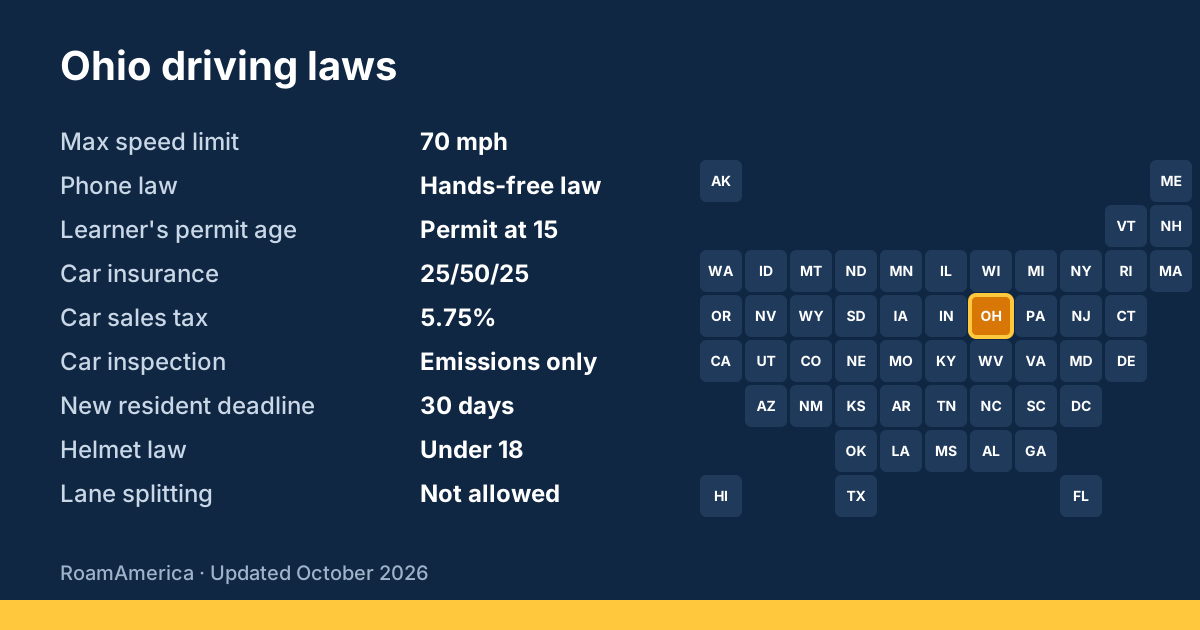
Ohio driving laws: speed limits
The maximum speed limit in Ohio is 70 mph. Rural interstates are posted at up to 70 mph and urban freeways up to 65 mph.
| Ohio: Top posted speed | 70 mph |
|---|---|
| Rural interstates | 70 mph |
| Urban interstates | 65 mph |
On major roads such as I-71 and I-75, signs are often lower than 70 mph, especially around Columbus and in work zones.
Motorists also have to keep a speed reasonable for the conditions, even below the posted number.
Bottom line, under Ohio driving laws: max speed limit, 70 mph.
Ohio driving laws: cell phone and texting law
Only hands-free. Ohio has a hands-free law: motorists are not allowed to hold a phone to call, text or scroll while driving. Voice calls through the car and a mounted map are fine.
| Ohio: Hand-held phone use (all motorists) | Banned |
|---|---|
| Texting behind the wheel | Banned |
| Teen phone ban | Drivers under 18 |
Ohio's hands-free law took effect in April 2023.
Under the Ohio driving laws, a phone in a mount, a voice assistant and a single tap to take a call or start navigation are allowed; holding the phone in traffic is not.
Rules are tighter for teenagers: in Ohio, drivers under 18 cannot touch a phone at all, not even through Bluetooth.
Bottom line, under Ohio driving laws: phone law, hands-free law.
Ohio driving laws: driving age and teen licenses
In Ohio, teenagers can get a learner's permit at 15 and a provisional (intermediate) license at 16; limits on night driving and passengers obey.
| Ohio: Learner's permit | Age 15 |
|---|---|
| Intermediate (provisional) license | Age 16 |
| Supervised driving hours | 50 (10 at night) |
| Full privileges | After 24 months licensed (minimum age 18) |
Before the road test, permit holders in Ohio log 50 hours (10 at night) of supervised driving.
At a glance, under Ohio driving laws: learner's permit age, permit at 15.
Ohio driving laws: minimum car insurance
Ohio requires at least 25/50/25 in liability coverage: $25,000 for injuries to one person, $50,000 for all injuries in one crash and $25,000 for property damage.
| Ohio: Injury limit per person | $25,000 |
|---|---|
| Per-accident injury coverage | $50,000 |
| Property damage limit | $25,000 |
| Other required coverage | None |
| Fault system | At-fault |
| Coverage mandatory by law | Yes |
Ohio follows the at-fault system, so the at-fault driver answers for the other drivers' injuries and damage via their liability insurance.
A minimum policy seldom pays for a serious crash, since medical bills plus a replacement car can top $50,000 fast.
Many agents suggest at least 100/300/100, since damages above your limits can be taken from your savings.
At a glance, under Ohio driving laws: car insurance, 25/50/25.
Ohio driving laws: car sales tax
Ohio applies a 5.75% state sales tax on vehicles you buy, and local taxes can come on top.
| Ohio: State-level rate | 5.75% (sales tax) |
|---|---|
| Local taxes added | Yes, in some areas |
| Trade-in lowers tax | Yes |
| Example: $30,000 car | $1,725 |
A trade-in is deducted only for new vehicles bought from a dealer. County taxes are added on top.
- A $21,500 car in Ohio: around $1,236 in state tax
- A $37,250 car in Ohio: roughly $2,142 in state tax
- A $55,000 car in Ohio: roughly $3,163 in state tax
A trade-in lowers the Ohio driving laws: a $30,000 car with a $5,000 trade-in owes around $1,438 rather than $1,725.
In short, under Ohio driving laws: car sales tax, 5.75%.
Ohio driving laws: car inspection and emissions
Only an emissions test. Ohio does not require periodic safety checks, but does require emissions testing in seven counties in the Cleveland area (E-Check).
| Ohio: Safety check | Not required |
|---|---|
| Emissions test | Some areas: seven counties in the Cleveland area (E-Check) |
Since no safety inspection is required in Ohio, maintaining brakes and tires in shape is up to the owner.
Smog checks on recent models read the on-board computer, which takes a few minutes; a lit check-engine light generally means an automatic fail.
At a glance, under Ohio driving laws: car inspection, emissions only.
Ohio driving laws: license and registration deadlines for newcomers
After moving to Ohio, you have 30 days to get a Ohio driver's license, and 30 days to register your car.
| Ohio: License deadline | 30 days |
|---|---|
| Vehicle registration | 30 days |
| Insurance minimum | 25/50/25 |
| Inspection | Emissions only |
Step-by-step list for Ohio driving laws
- Apply for a Ohio driver's license: 30 days. Take an ID document, your SSN and two proofs of address when you visit the Ohio BMV (REAL ID rules).
- Set up car insurance that meets the minimum: Ohio sets a floor of 25/50/25. Coverage is generally required before registration.
- Inspection: Only an emissions test. Ohio skips safety inspections, but requires emissions testing in seven counties in the Cleveland area (E-Check).
- Title and register the car: 30 days at the deputy registrar.
The clock generally begins when you start work, rent a home or enroll children in school in Ohio, not on the day the boxes arrive.
Bottom line, under Ohio driving laws: new resident deadline, 30 days.
Ohio driving laws: motorcycle helmet law
Only for riders under 18. In Ohio, motorcyclists 17 and younger must wear a helmet; motorcyclists 18 and older may legally go without one. From Cleveland to the capital, Columbus, the same statewide rule applies.
| Ohio: Helmets mandatory for | Riders 17 and younger |
|---|---|
| Law type | Partial (age-based) |
| Adults may ride without a helmet | Yes |
Riders 17 and younger must wear a helmet under the Ohio driving laws; at 18 it becomes optional.
Riders in their first year of licensing, and their passengers, must also wear a helmet.
NHTSA estimates that helmets reduce over a third of rider deaths in serious crashes, and about 41% for passengers.
A compliant helmet carries the DOT symbol on the back; thin novelty shells without it are not legal.
At a glance, under Ohio driving laws: helmet law, under 18.
Ohio driving laws: lane splitting
No. Splitting and filtering are not legal in Ohio. Motorcycles must use a full lane, and riders cannot ride between cars or ride on the lane line.
| Ohio: Riding between moving lanes | Not legal |
|---|---|
| Filtering at a stop | Not legal |
| Law dates from | — |
Because no statute permits it, Ohio driving laws is treated as an illegal pass or an unsafe lane change, and a crash while splitting can count against the rider.
In short, under Ohio driving laws: lane splitting, not permitted.
Where the Ohio driving laws stand out
- Ohio sits near the middle of the national range on every topic we track, so few rules in the Ohio driving laws will surprise newcomers from nearby states.
Getting around Ohio
Most long trips use I-71, I-75 and I-70, which tie together Columbus, Cleveland and Columbus. Each of these routes falls under Ohio driving laws.
Licenses come from the Ohio BMV, and plates and titles come from the deputy registrar.
All of the Ohio driving laws above apply statewide, whether in Columbus or in rural counties.
Next door
- Indiana: car sales tax 7% (vs. 5.75%)
- Kentucky: car sales tax 6% (vs. 5.75%); helmet law Under 21 (vs. Under 18)
- Michigan: max speed limit 75 mph (vs. 70 mph); 6% for car sales tax, against 5.75%; 50/100/10 for car insurance, against 25/50/25
- Pennsylvania: car sales tax of 6% instead of 5.75%; car insurance 15/30/5 (vs. 25/50/25); Under 21 for helmet law, against Under 18
- West Virginia: car sales tax 6% (vs. 5.75%); All motorcyclists for helmet law, against Under 18
Questions about the Ohio driving laws
Do the Ohio driving laws change for trucks?
Most roads in Ohio use the same limit for passenger vehicles and big rigs; look for truck-only limits.
Can an officer stop you solely for violating the Ohio driving laws?
Yes. In Ohio it is usually primary enforcement, so an officer can stop you for it even with no other violation.
May a 15-year-old drive unsupervised under the Ohio driving laws rules?
No. Driving alone starts with the provisional license at 16 in Ohio.
What if I drive without Ohio driving laws?
Driving without coverage in Ohio can bring penalties, a suspended license and registration, and personal liability for the damage you cause.
Is the Ohio driving laws owed on used vehicles?
Yes. A used car is taxed the same way, and private sales can be taxed at a minimum or a standard value.
Is a Ohio driving laws required to sell a car?
Not by law in Ohio, although a pre-purchase check is smart.
Does an adult have to obey the Ohio driving laws?
No. Only motorcyclists 17 and younger need one in Ohio; motorcyclists in their first year of licensing, and their passengers, must also wear a helmet.
Is moving up at a light part of Ohio driving laws?
No. Riding between stopped cars at a light is not allowed in Ohio too.