State guide · Updated October 2026
California Driving Laws (2026): Speed, Phone, Insurance, Tax
California sits in the West census region, with Sacramento as its capital and Los Angeles and San Diego among its largest cities. This guide collects the California driving laws people search for most, from speed limits and phone use to coverage, taxes, inspections and riding.
Every section below answers one question in detail, with the facts, the figures and how it compares nationally; we last verified the numbers on October 25, 2026 for California.
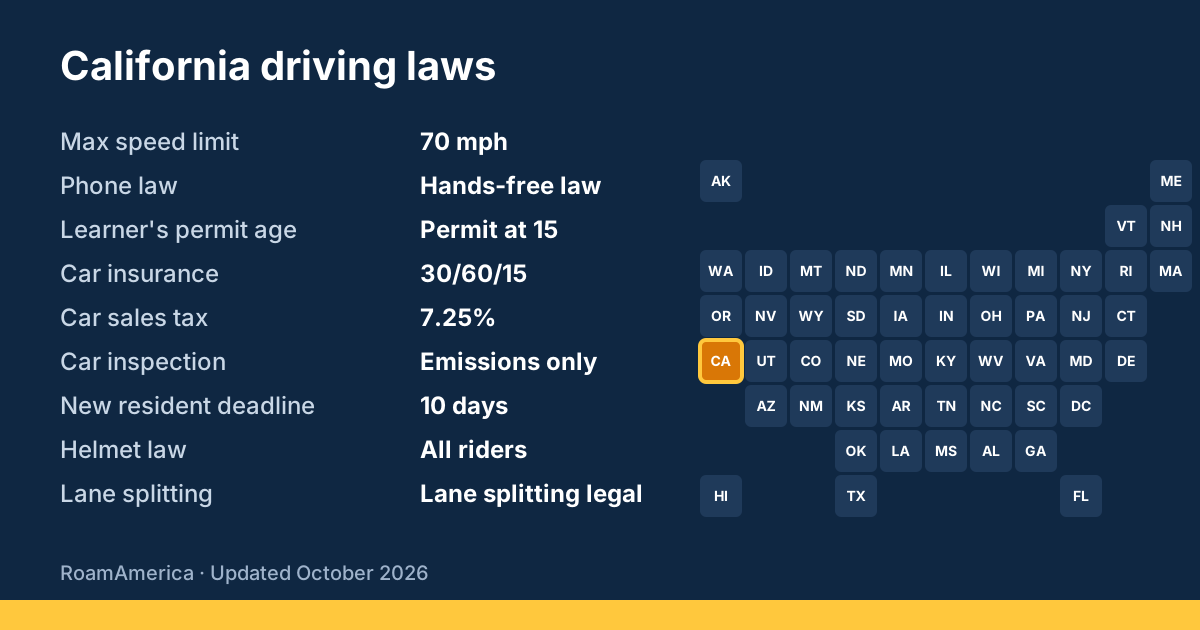
California driving laws: speed limits
The maximum speed limit in California is 70 mph. Rural interstates reach up to 70 mph and urban freeways at up to 65 mph.
| California: Highest posted limit | 70 mph |
|---|---|
| Rural freeways | 70 mph |
| City freeways | 65 mph |
Trucks and vehicles towing a trailer are limited to 55 mph on all roads.
On major roads such as I-5 and I-405, posted limits are frequently lower than 70 mph, especially through Los Angeles and in work zones.
Drivers must also keep a speed that suits rain, fog and traffic, even under the limit; police may cite unsafe speed on its own.
Bottom line, under California driving laws: max speed limit, 70 mph.
California driving laws: cell phone and texting law
Only hands-free. California enforces a hands-free law: anyone driving are not permitted to hold a phone to talk, text or browse while driving. Bluetooth calls and mounted navigation remain legal.
| California: Holding a phone while driving | Banned |
|---|---|
| Texting behind the wheel | Banned |
| Total phone ban for teenagers | Drivers under 18 |
Under the California driving laws, a dash-mounted phone, voice commands and a single tap to pick up a call or begin a route are permitted; holding the phone, even at a red light, is the offense.
Teen motorists face more: in California, drivers under 18 cannot touch a phone at all, not even through Bluetooth.
Bottom line, under California driving laws: phone law, hands-free law.
California driving laws: driving age and teen licenses
In California, teens can obtain a learner's permit at 15 and a provisional (intermediate) license at 16, with night and passenger limits after that.
| California: Permit age | Age 15 |
|---|---|
| Provisional license | Age 16 |
| Supervised driving hours | 50 (10 at night) |
| Unrestricted license | After 12 months licensed (minimum age 17) |
To qualify for the road test, teens in California must log 50 hours (10 at night) of supervised driving.
In short, under California driving laws: learner's permit age, permit at 15.
California driving laws: minimum car insurance
California sets a minimum of 30/60/15 in liability insurance: $30,000 for injuries to one person, $60,000 for all injuries in one crash and $15,000 for property damage.
| California: Injury limit per person | $30,000 |
|---|---|
| Injury limit per crash | $60,000 |
| Damage to property | $15,000 |
| Other mandatory coverage | None |
| Fault system | At-fault |
| Coverage required by law | Yes |
The minimums rose from 15/30/5 to 30/60/15 on January 1, 2025. A low-cost program offers lower limits to eligible low-income motorists.
California follows the at-fault system, so the at-fault driver pays for the other people's injuries and damage through their policy.
A minimum policy often falls short in a serious crash: hospital bills and a new car may top $60,000 quickly.
Consumer groups suggest limits like 100/300/100, as anything above your limits can be claimed from you personally.
In short, under California driving laws: car insurance, 30/60/15.
California driving laws: car sales tax
California applies a 7.25% state sales tax on vehicle purchases, and local taxes can add to that.
| California: State rate | 7.25% (sales tax) |
|---|---|
| Local add-ons | Yes, in some areas |
| Trade-in credit | No |
| Example: $30,000 car | $2,175 |
California does not deduct a trade-in from the taxable price. District taxes bring the total to between 7.25% and over 10% depending on where you register the car.
- A $18,400 car in California: roughly $1,334 in state tax
- A $32,600 car in California: roughly $2,364 in state tax
- A $55,000 car in California: around $3,988 in state tax
California taxes the full price, so a trade-in does not reduce the California driving laws.
Bottom line, under California driving laws: car sales tax, 7.25%.
California driving laws: vehicle inspection and emissions
Only an emissions test. California does not require periodic safety checks, but does require emissions testing statewide.
| California: Safety check | Not required |
|---|---|
| Emissions testing | Statewide |
Most gasoline vehicles more than eight model years old need a Smog Check every two years, and when sold or first registered in California.
Since no safety inspection is mandatory in California, keeping brakes and tires in good order is your responsibility.
Emissions tests on newer cars read the on-board computer through the OBD port; a lit check-engine light generally means an automatic fail.
In short, under California driving laws: car inspection, emissions only.
California driving laws: license and registration deadlines for newcomers
After moving to California, you have 10 days to obtain a California driver's license, and 20 days to register your car.
| California: Switch your license | 10 days |
|---|---|
| Register your car | 20 days |
| Required insurance | 30/60/15 |
| Inspection | Emissions only |
Step-by-step list for California driving laws
- Get a California driver's license: 10 days. Take an ID document, your SSN and two proofs of address to the California DMV; REAL ID rules apply.
- Buy car insurance that meets the minimum: California requires 30/60/15. A policy is generally required before registration.
- Inspection: Only an emissions test. California does not require periodic safety checks, but requires emissions testing statewide.
- Register and title your car: 20 days at the California DMV.
The clock generally begins once you begin a job, sign a lease or put children in a local school in California, not on the day the boxes arrive.
At a glance, under California driving laws: new resident deadline, 10 days.
California driving laws: motorcycle helmet law
Yes. California has a universal helmet law: every rider and every passenger must wear a DOT-approved helmet, whatever their age. Whether you are on I-5 near Los Angeles or on US-101, the law stays the same.
| California: Who must wear a helmet | All riders and passengers |
|---|---|
| Type of law | Universal |
| Adult riders exempt | No |
Under the California driving laws, operators and passengers of any age must wear a helmet on any motorcycle, including mopeds that require an endorsement.
Crash research suggests that helmets prevent about over a third of rider deaths in crashes, and about 41% of passenger deaths.
A legal helmet carries the DOT label on the back; novelty helmets that lack it do not count.
At a glance, under California driving laws: helmet law, all motorcyclists.
California driving laws: lane splitting
Yes. California is the only state where lane splitting is fully legal. Motorcyclists may ride between lanes of slow or stopped traffic as long as it is done safely.
| California: Lane splitting (moving traffic) | Legal |
|---|---|
| Passing stopped vehicles | Legal |
| Legal since | 2017 |
California is the only state that fully allows lane splitting. AB 51 (effective January 2017) defined it in law; the CHP publishes safety guidelines rather than a fixed speed limit.
Where it is permitted, California driving laws is still subject to reckless-driving rules, so police can stop a rider who goes too fast.
Bottom line, under California driving laws: lane splitting, lane splitting legal.
Where the California driving laws stand out
- Car sales tax: 7.25%, the higher anywhere in the US
- Lane splitting: Lane splitting legal — the more permissive anywhere in the US
Driving around California
Key highways include I-5, I-405 and US-101, linking Los Angeles, San Diego and Sacramento, the capital. Each of these routes falls under California driving laws.
Licenses come from the California DMV, and plates and titles go through the California DMV.
Every rule on this page applies across the state, whether in Los Angeles or in rural counties.
Across the border
- Arizona: 75 mph for max speed limit, against 70 mph; car sales tax 5.6% (vs. 7.25%); car insurance 25/50/15 (vs. 30/60/15)
- Nevada: max speed limit 80 mph (vs. 70 mph); car sales tax of 6.85% instead of 7.25%; 25/50/20 for car insurance, against 30/60/15
- Oregon: car sales tax 0.5% (vs. 7.25%); car insurance of 25/50/20 instead of 30/60/15
Questions about the California driving laws
Do the California driving laws differ for trucks?
Trucks and vehicles towing a trailer are limited to 55 mph on all roads.
Will police pull over motorists solely for ignoring the California driving laws?
Yes. In California it is generally primary enforcement, so an officer may stop you for it even with no other violation.
May a 15-year-old drive unsupervised under the California driving laws laws?
No. Driving alone begins after you receive the provisional license at 16 in California.
Can I drive without California driving laws?
Driving without coverage in California can bring penalties, suspension of your license and plates, and personal liability for any damage.
Is the California driving laws owed on used cars?
Yes. Used vehicles pay it as well, and private sales may be valued at a minimum or a standard value.
Is a California driving laws required to sell a car?
Generally not in California, although a pre-purchase check is smart.
Does an adult need to obey the California driving laws?
Yes. Anyone on the bike in California must wear a helmet.
Is moving up at a light part of California driving laws?
Yes, filtering is covered within the same speed limits.
Travel ideas in California
- Place to visitYosemite National ParkGranite walls a kilometer high, thundering waterfalls and trees older than most civilizations.
- Place to visitAlcatraz IslandAmerica’s most famous prison, a short ferry ride and a world away from San Francisco.
- Place to visitSan FranciscoCable cars, rolling fog and painted houses on the steepest streets you have ever seen.
- Place to visitGolden Gate BridgePainted orange to shine through the fog, and still one of the most beautiful bridges on Earth.
- Place to visitJoshua Tree National ParkWhere two deserts meet, among spiky trees and giant piles of boulders.
- Place to visitDeath Valley National ParkThe hottest, driest and lowest national park, and far more colorful than its name.