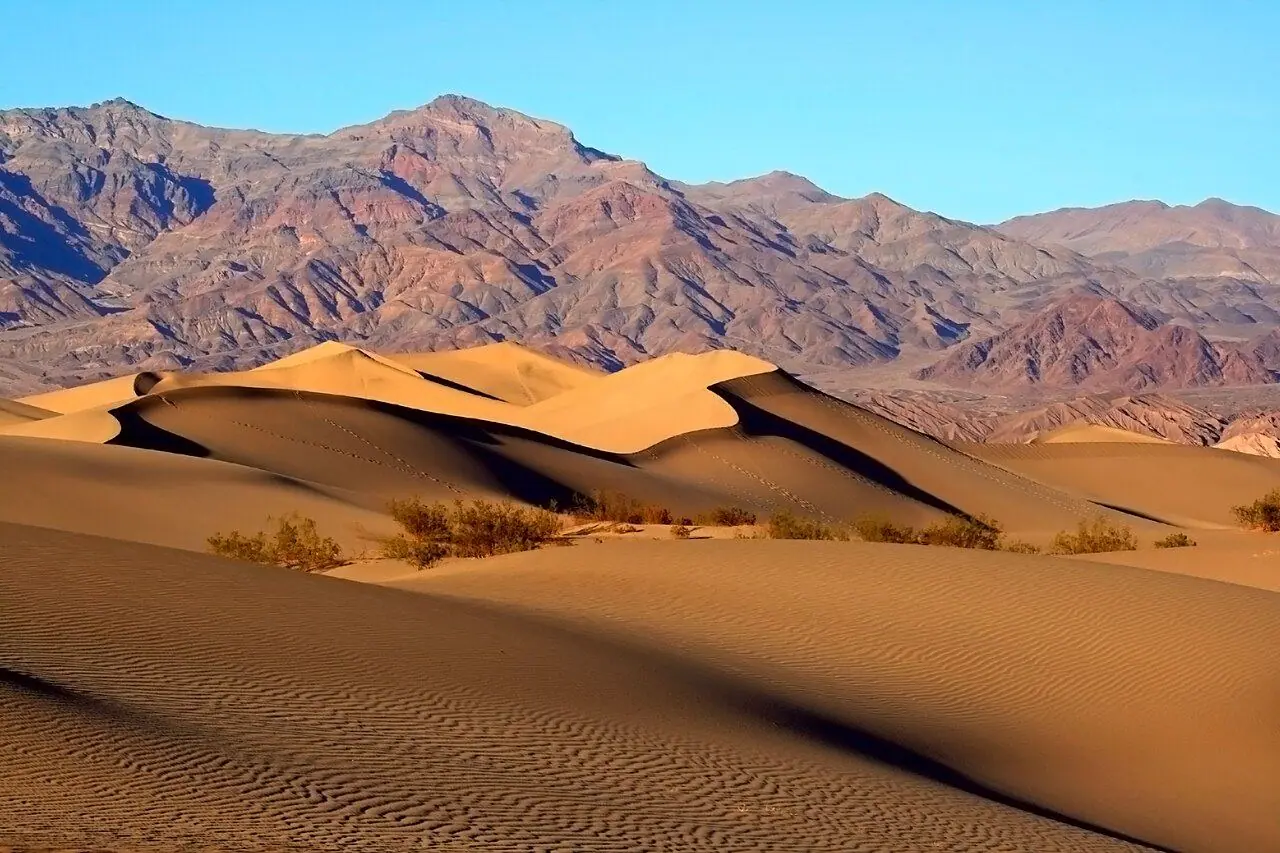
Death Valley National Park
The hottest, driest and lowest national park, and far more colorful than its name.
Photo: Brocken Inaglory · CC BY-SA 3.0
Death Valley guide: Badwater Basin, Zabriskie Point, Artist’s Palette, the Mesquite Flat dunes, Dante’s View, summer heat safety and the best season.
What to expect
Death Valley is the largest national park in the lower 48 states, a land of salt flats, sand dunes and colorful badlands between the Sierra Nevada and the Nevada border. Badwater Basin lies 86 meters below sea level, the lowest point in North America, and Furnace Creek holds the record for the hottest air temperature ever measured on Earth.
Most sights are near Furnace Creek. Zabriskie Point is the classic sunrise view over golden, rippled hills; Artist’s Drive loops past Artist’s Palette, where minerals paint the slopes pink, green and purple; and Dante’s View looks straight down on Badwater from 1,669 meters up.
The Mesquite Flat Sand Dunes near Stovepipe Wells are best at sunrise or sunset, when the ripples cast long shadows. Distances are huge, phone service is rare and the few gas stations inside the park are expensive, so plan your fuel and water with care.
Las Vegas is the nearest major airport, about two hours from Furnace Creek by car. Inside the park, The Oasis at Death Valley in Furnace Creek and Stovepipe Wells Village have rooms, restaurants and gas, and there are campgrounds at Furnace Creek, Stovepipe Wells and Texas Springs. For cheaper rooms, many travelers stay in Beatty or Pahrump on the Nevada side.
Death Valley: top things to do
- 1Walking out onto the salt flats of Badwater Basin
- 2Sunrise at Zabriskie Point
- 3Artist’s Drive in late-afternoon light
- 4The Mesquite Flat Sand Dunes at sunset
Death Valley: best time to visit
November to March. From May to September the midday heat is dangerous; hike only early in the morning.
Insider tips
- Carry extra water in the car and download offline maps; there is no signal in most of the park.
- Fill up before you drive in, since fuel inside the park costs much more.
- If your car breaks down in summer, stay with it rather than walking for help.
Fees, passes and parking
| What | Price |
|---|---|
| Private vehicle | $30 per vehicle, 7 days |
| Motorcycle | $25 per vehicle, 7 days |
| Per person (on foot or bike) | $15 per person, 7 days |
| Annual pass for this park | $55 per year |
- America the Beautiful pass accepted: $80 a year for US residents, $250 for others (also covers the $100 fee).
- US residents enter free on a few fee-free days.
Checked Oct 26, 2026. Official prices
Gas and fast charging nearby
2 gas stations within 20 km
- 12.8 km Stovepipe Wells Gas Station open 24 hours
- 19.8 km Furnace Creek Fuel and Auto Service Unbranded · diesel
No fast (DC) chargers within 20 km; plan to arrive with enough range.
OpenStreetMap data, Oct 28, 2026.
Photo gallery
No reviews yet. Been here? Be the first to share your tips!
Traveler reviews