State guide · Updated October 2026
Utah Driving Laws (2026): Speed Limits, Insurance and More
Utah sits in the West census region, with Salt Lake City as the capital and Salt Lake City and West Valley City among its largest cities. This page gathers the Utah driving laws people search for most, from speed limits and phone use to coverage, taxes, inspections and riding.
Each section below covers one rule in detail, with key facts and the national picture; we last verified the numbers on October 25, 2026.
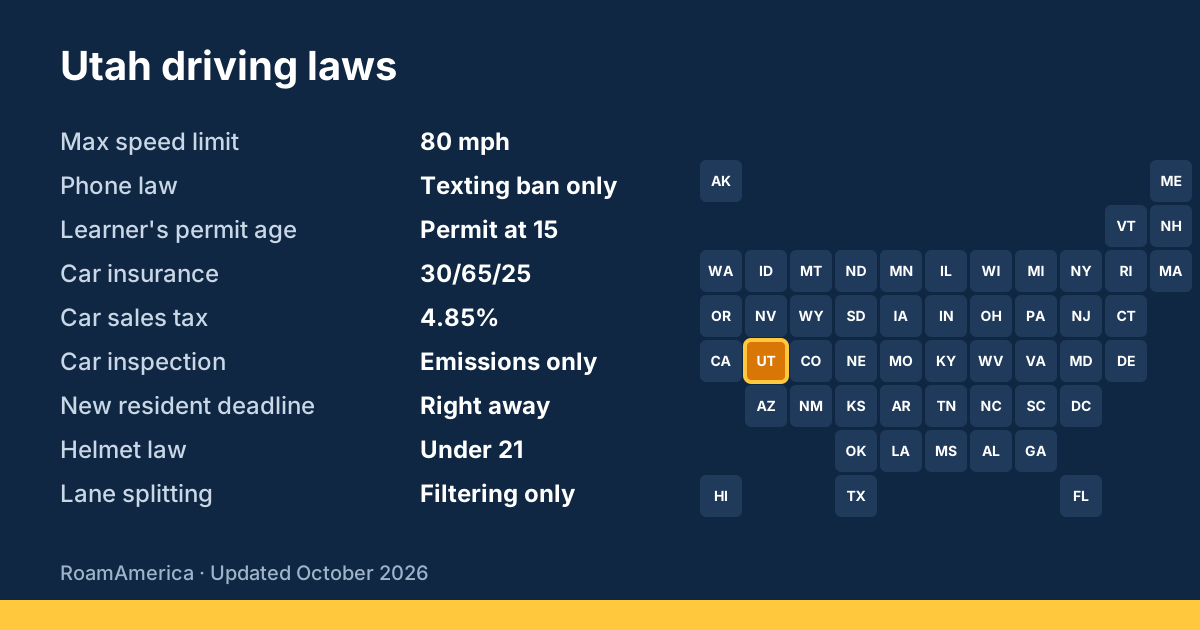
Utah driving laws: speed limits
The highest speed limit in Utah is 80 mph. Rural interstates are posted at up to 75 mph and urban interstates up to 70 mph.
| Utah: Highest posted limit | 80 mph |
|---|---|
| Rural freeways | 75 mph |
| Interstates in cities | 70 mph |
80 mph is posted on designated rural interstate segments.
On major roads such as I-15 and I-80, signs are frequently below 80 mph, especially around Salt Lake City and in work zones.
Motorists also need to keep a speed that suits weather and traffic, even under the limit.
In short, under Utah driving laws: max speed limit, 80 mph.
Utah driving laws: cell phone and texting law
Yes for calls, no for texting. Utah bans texting while driving for all drivers, but adults can still use a hand-held phone to make calls.
| Utah: Hand-held calls | Allowed |
|---|---|
| Sending texts while driving | Banned |
| Total phone ban for teenagers | Drivers under 18 |
Dialing or manipulating a hand-held phone is banned; talking on a hand-held phone is not.
Texting rules apply to each driver in Utah, but talking on a hand-held phone for a call is not banned statewide once you are licensed as an adult.
Young motorists obtain a stricter rule: in Utah, motorists under 18 cannot touch a phone at all, hands-free included.
Bottom line, under Utah driving laws: phone law, texting ban only.
Utah driving laws: driving age and teen licenses
Young drivers in Utah can obtain a learner's permit at 15 and an intermediate (provisional) license at 16; limits on night driving and passengers obey.
| Utah: Permit age | Age 15 |
|---|---|
| Provisional license | Age 16 |
| Hours with an adult | 40 (10 at night) |
| All limits lifted | After 6 months licensed or at 18, whichever comes first |
Before the road test, new drivers in Utah must log 40 hours (10 at night) of supervised driving.
At a glance, under Utah driving laws: learner's permit age, permit at 15.
Utah driving laws: minimum car insurance
Utah requires motorists to carry at least 30/65/25 in liability insurance: $30,000 for one injured person, $65,000 for all injuries in one accident and $25,000 for property damage. You also need personal injury protection (PIP).
| Utah: Per-person injury coverage | $30,000 |
|---|---|
| Injury limit per crash | $65,000 |
| Property damage limit | $25,000 |
| Extra mandatory coverage | PIP |
| Claims system | No-fault |
| Coverage required by law | Yes |
Minimums rose from 25/65/15 to 30/65/25 on January 1, 2025.
Utah is a no-fault state: your own PIP pays your medical bills first following a crash, and lawsuits against the other driver is limited to serious injuries.
Required on top of liability in Utah: personal injury protection (PIP).
Bare-minimum coverage rarely covers a serious crash: treatment and repairs may top $65,000 quickly.
Consumer groups suggest at least 100/300/100, since costs beyond the policy can be collected from you directly.
In short, under Utah driving laws: car insurance, 30/65/25.
Utah driving laws: car sales tax
Utah collects a 4.85% state sales tax on cars you buy, and local taxes can raise the total.
| Utah: Statewide rate | 4.85% (sales tax) |
|---|---|
| Local add-ons | Yes, in some areas |
| Trade-in credit | Yes |
| State tax on a $30,000 car | $1,455 |
- A $22,400 car in Utah: roughly $1,086 in state tax
- A $38,600 car in Utah: around $1,872 in state tax
- A $55,000 car in Utah: roughly $2,668 in state tax
A trade-in reduces the Utah driving laws: a $30,000 car with a $5,000 trade-in owes roughly $1,213 compared with $1,455.
In short, under Utah driving laws: car sales tax, 4.85%.
Utah driving laws: vehicle inspection and emissions
Only an emissions test. Utah skips safety inspections, but does require emissions testing in Cache, Davis, Salt Lake, Utah and Weber counties.
| Utah: Safety check | Not required |
|---|---|
| Emissions test | Some areas: Cache, Davis, Salt Lake, Utah and Weber counties |
With no regular safety check in Utah, maintaining brakes, lights and tires in good order is the owner's job.
Smog checks on recent models read the on-board computer, which takes a few minutes; a lit check-engine light generally means a failure.
In short, under Utah driving laws: car inspection, emissions only.
Utah driving laws: license and registration deadlines for newcomers
After moving to Utah, you have right away, as soon as you become a resident to obtain a Utah driver's license, and 60 days to register your car.
| Utah: New driver's license | Right away |
|---|---|
| Plate deadline | 60 days |
| Minimum car insurance | 30/65/25 |
| Vehicle check | Emissions only |
Utah law has no grace period for switching to a Utah driver's license, so apply as soon as you become a resident.
Checklist for Utah driving laws
- Get a Utah driver's license: Right away, as soon as you become a resident. Take proof of identity, your Social Security number and two proofs of address to the Utah Driver License Division (REAL ID laws).
- Set up car insurance at or above the minimum: Utah sets a floor of 30/65/25. Coverage is generally mandatory ahead of registration.
- Inspection: Only an emissions test. Utah has no regular safety inspection, but requires emissions testing in Cache, Davis, Salt Lake, Utah and Weber counties.
- Register and title your car: 60 days at the Utah DMV.
The clock typically starts when you take a job, buy a house or register kids for school in Utah, not on the day the moving truck indicates up.
At a glance, under Utah driving laws: new resident deadline, right away.
Utah driving laws: motorcycle helmet law
Only if you are under 21. In Utah, motorcyclists 20 and younger are required to wear a helmet; motorcyclists 21 and older can legally ride without one. It is the same in Salt Lake City, in West Valley City and on quiet stretches of I-80.
| Utah: Helmet mandatory for | Riders 20 and younger |
|---|---|
| Kind of law | Partial (age-based) |
| Adult motorcyclists exempt | Yes |
Riders 20 and younger are required to wear a helmet under the Utah driving laws; at 21 a rider may decide.
Crash research suggests that helmets prevent about roughly 37% of rider deaths in crashes, and about 41% of passenger deaths.
A compliant helmet indicates the DOT label at the rear; thin novelty shells without it do not count.
At a glance, under Utah driving laws: helmet law, under 21.
Utah driving laws: lane splitting
Only lane filtering. Utah has permitted riders to move between stopped vehicles at low speed since 2019; splitting lanes in moving traffic is still illegal.
| Utah: Splitting in moving traffic | Not legal |
|---|---|
| Passing stopped cars | Legal |
| Law dates from | 2019 |
Since May 2019, riders can pass stopped vehicles at no more than 15 mph, on roads with a speed limit of 45 mph or less and two or more lanes in the same direction. The law is set to expire on July 1, 2027 unless the legislature renews it.
Where it is permitted, Utah driving laws is still subject to reckless-driving laws, so police can stop a rider who rides too fast for conditions.
At a glance, under Utah driving laws: lane splitting, filtering only.
Where the Utah driving laws stand out
- Max speed limit: 80 mph, in the faster group of 9 nationwide
- New resident deadline: Right away — among the shorter 5 in the US
- Lane splitting: Filtering only — among the more permissive 6 nationwide
Driving around Utah
Key highways include I-15, I-80 and I-70, which tie together Salt Lake City, West Valley City and Salt Lake City. Each of these routes falls under Utah driving laws.
Licenses come from the Utah Driver License Division, and plates and titles come from the Utah DMV.
All of the Utah driving laws above apply statewide, whether in Salt Lake City or in rural counties.
Across the border
- Arizona: 75 mph for max speed limit, against 80 mph; 5.6% for car sales tax, against 4.85%; 25/50/15 for car insurance, against 30/65/25
- Colorado: max speed limit of 75 mph instead of 80 mph; car sales tax 2.9% (vs. 4.85%); 25/50/15 for car insurance, against 30/65/25
- Idaho: car sales tax 6% (vs. 4.85%); car insurance 25/50/15 (vs. 30/65/25); Under 18 for helmet law, against Under 21
- Nevada: car sales tax of 6.85% instead of 4.85%; car insurance of 25/50/20 instead of 30/65/25; helmet law of All motorcyclists instead of Under 21
- New Mexico: max speed limit of 75 mph instead of 80 mph; 4% for car sales tax, against 4.85%; 25/50/10 for car insurance, against 30/65/25
- Wyoming: car sales tax of 4% instead of 4.85%; car insurance of 25/50/20 instead of 30/65/25; Under 18 for helmet law, against Under 21
Questions about the Utah driving laws
Do the Utah driving laws differ for trucks?
Most roads in Utah post the same limit for vehicles and trucks; watch for truck-only limits.
Will police pull over you just for breaking the Utah driving laws?
Yes. In Utah it is generally a primary offense, so you can be pulled over for it without any other reason.
Can a 15-year-old drive alone under the Utah driving laws rules?
No. Driving alone is allowed with the provisional license at 16 in Utah.
Can I drive without Utah driving laws?
Driving without coverage in Utah can bring penalties, suspension of your license and plates, and personal responsibility for any damage.
Is the Utah driving laws due on used cars?
Yes. Used cars are taxed too, and private sales may be valued at a minimum or a standard value.
Is a Utah driving laws required to sell a car?
Not by law in Utah, although buyers may ask for one.
Do adults have to obey the Utah driving laws?
No. Just motorcyclists 20 and younger must wear one in Utah.
Is filtering at a stoplight part of Utah driving laws?
Yes, that is what the law allows: since May 2019, riders can pass stopped vehicles at no more than 15 mph, on roads with a speed limit of 45 mph or less and two or more lanes in the same direction. The law is set to expire on July 1, 2027 unless the legislature renews it.
Travel ideas in Utah
- Place to visitZion National ParkHike up a river through a canyon of red and cream cliffs, or climb a ridge with drops on both sides.
- Place to visitArches National ParkMore than 2,000 stone arches: nowhere else on Earth has so many in one place.
- Place to visitMonument ValleyThe Wild West of the movies is real, and it belongs to the Navajo Nation.
- Place to visitBryce Canyon National ParkThousands of orange stone spires stand packed together like a frozen crowd.
- Place to visitCanyonlands National ParkUtah’s largest national park, carved by two rivers into a maze of canyons, mesas and buttes.
- Place to visitCapitol Reef National ParkA 160-kilometer wrinkle in the Earth, with pioneer orchards where you can pick fruit in season.