State guide · Updated October 2026
Michigan Driving Laws (2026): Speed, Phone, Insurance, Tax
Michigan belongs to the Midwest region, with Lansing as its capital and Detroit and Grand Rapids as its biggest cities. This page gathers the Michigan driving laws that matter most, from speed and phones through insurance, car tax and motorcycles.
Every section below explains one rule in full, with key facts and the national picture, and the figures were last checked October 25, 2026 for Michigan.
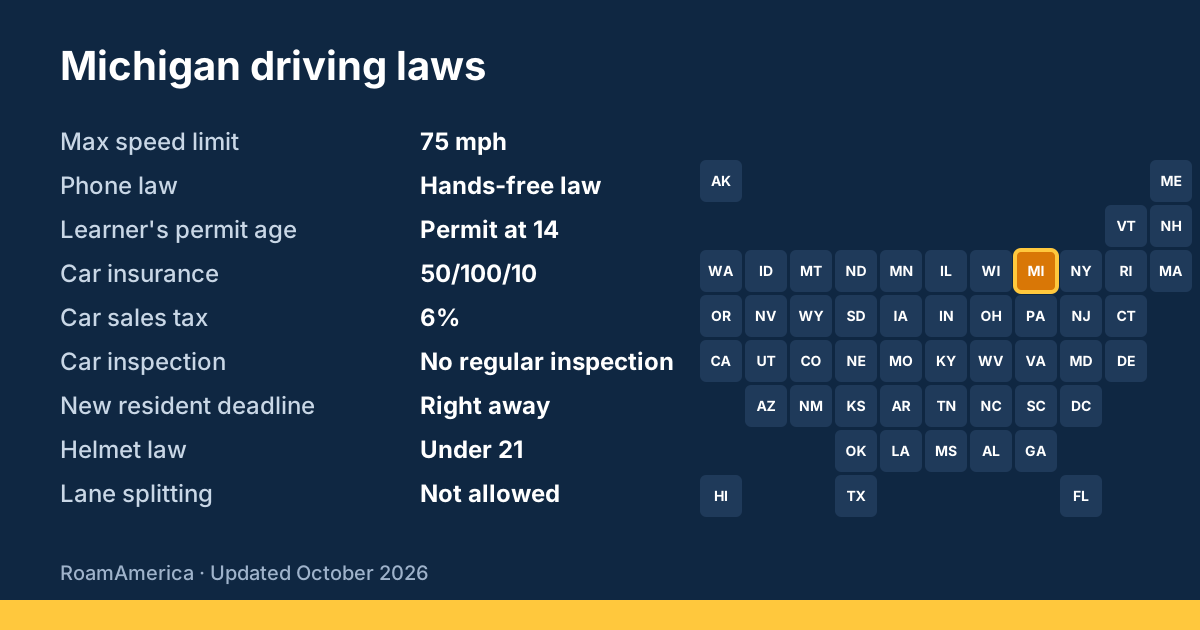
Michigan driving laws: speed limits
The top speed limit in Michigan is 75 mph. Interstates carry limits of up to 70 mph in both rural and urban areas.
| Michigan: Top posted speed | 75 mph |
|---|---|
| Rural interstates | 70 mph |
| City freeways | 70 mph |
75 mph is posted on designated rural freeway segments (65 mph for trucks).
On busy roads such as I-75 and I-94, signs are frequently lower than 75 mph, especially through Detroit and in work zones.
Drivers must also keep a speed reasonable for weather and traffic, even below the posted number.
In short, under Michigan driving laws: max speed limit, 75 mph.
Michigan driving laws: cell phone and texting law
Only hands-free. Michigan has a hands-free law: anyone driving cannot hold a phone to talk, text or browse while driving. Voice calls through the car and a mounted map are fine.
| Michigan: Hand-held phone use (all drivers) | Banned |
|---|---|
| Texting while driving (all drivers) | Banned |
| Total phone ban for teenagers | No |
Under the Michigan driving laws, a dash-mounted phone, spoken commands and one swipe to pick up a call or start navigation are allowed; picking it up in traffic is the offense.
Bottom line, under Michigan driving laws: phone law, hands-free law.
Michigan driving laws: driving age and teen licenses
Young drivers in Michigan can apply for a learner's permit at 14 and an intermediate (provisional) license at 16, with night and passenger limits after that.
| Michigan: Learner's permit | Age 14 |
|---|---|
| Intermediate (provisional) license | Age 16 |
| Practice hours | 50 (10 at night) |
| Unrestricted license | Age 17 and 6 months licensed, or 18 |
To qualify for the road test, new drivers in Michigan log 50 hours (10 at night) of supervised driving.
In short, under Michigan driving laws: learner's permit age, permit at 14.
Michigan driving laws: minimum car insurance
Michigan requires at least 50/100/10 in liability coverage: $50,000 for injuries to one person, $100,000 for all injuries in one crash and $10,000 for property damage. You also need personal injury protection (PIP) and property protection insurance (PPI).
| Michigan: Per-person injury coverage | $50,000 |
|---|---|
| Bodily injury per accident | $100,000 |
| Property damage limit | $10,000 |
| Other mandatory coverage | PIP, PPI |
| At-fault or no-fault | No-fault |
| Insurance mandatory | Yes |
Policies default to 250/500 bodily injury; you may choose limits as low as 50/100 in writing. Property protection insurance (PPI) of $1 million for damage in Michigan is also required.
Michigan is a no-fault state: your own PIP covers your medical bills first following a crash, and lawsuits against the other driver are limited to serious injuries.
Also mandatory in Michigan: personal injury protection (PIP) and property protection insurance (PPI).
A minimum policy rarely covers a serious crash, since hospital bills and a new car can top $100,000 quickly.
Many agents suggest a floor of 100/300/100, since costs beyond the policy can be claimed from you personally.
In short, under Michigan driving laws: car insurance, 50/100/10.
Michigan driving laws: car sales tax
Michigan collects a 6% state sales tax on vehicle purchases. Cities and counties add nothing.
| Michigan: State-level rate | 6% (sales tax) |
|---|---|
| Local add-ons | No |
| Trade-in deducted | Limited |
| State tax on a $30,000 car | $1,800 |
Only part of a trade-in's value is deducted; the cap rises each year until the full value is deductible.
- A $20,200 car in Michigan: roughly $1,212 in state tax
- A $35,300 car in Michigan: roughly $2,118 in state tax
- A $55,000 car in Michigan: around $3,300 in state tax
Trade-in credit in Michigan is limited, so the Michigan driving laws may be close to the full-price figure.
Bottom line, under Michigan driving laws: car sales tax, 6%.
Michigan driving laws: vehicle inspection and emissions
No. Michigan does not require periodic safety inspections or emissions tests for passenger vehicles.
| Michigan: Safety inspection | Not mandatory |
|---|---|
| Emissions test | Not required |
Since no safety inspection is mandatory in Michigan, maintaining brakes and tires in good order is up to the owner.
Bottom line, under Michigan driving laws: car inspection, no regular inspection.
Michigan driving laws: license and registration deadlines for new residents
After moving to Michigan, you have right away, as soon as you become a resident to obtain a Michigan driver's license, and right away, as soon as you become a resident to register your car.
| Michigan: License deadline | Right away |
|---|---|
| Vehicle registration | Right away |
| Required insurance | 50/100/10 |
| Inspection | No regular inspection |
Michigan requires newcomers to get a Michigan license and register their vehicles as soon as they become residents.
Checklist for Michigan driving laws
- Apply for a Michigan driver's license: Right away, as soon as you become a resident. Take an ID document, your SSN and two proofs of address to the Michigan Secretary of State; REAL ID rules apply.
- Buy car insurance at or above the minimum: Michigan requires 50/100/10. Coverage is generally needed before registration.
- Vehicle check: No periodic inspection, though a VIN check may be mandatory for an out-of-state vehicle.
- Title and register the car: Right away, as soon as you become a resident at the Michigan Secretary of State.
The clock generally starts when you start work, buy a house or put children in a local school in Michigan, not on the day the truck arrives.
In short, under Michigan driving laws: new resident deadline, right away.
Michigan driving laws: motorcycle helmet law
Only for riders under 21. In Michigan, riders and passengers 20 and younger are required to wear a helmet; adults 21 and older may legally ride without one. Whether you are on I-75 close to Detroit or on I-96, the law stays the same.
| Michigan: Helmets mandatory for | Riders 20 and younger |
|---|---|
| Type of law | Partial (age-based) |
| Adults may ride without a helmet | Yes, with conditions |
Riders 20 and younger must wear a helmet under the Michigan driving laws; at 21 a rider can decide.
Riders 21 and older may ride without a helmet if they have held the endorsement for two years or passed a safety course, and carry at least $20,000 in first-party medical coverage.
Crash research suggests that helmets prevent roughly 37% of rider deaths in serious crashes, and around 41% for passengers.
A legal helmet indicates the DOT label on the back; thin novelty shells that lack it are not legal.
Bottom line, under Michigan driving laws: helmet law, under 21.
Michigan driving laws: lane splitting
No. Splitting and filtering are not legal in Michigan. Each motorcycle gets its own full lane, and motorcyclists are not allowed to squeeze between cars or ride between lanes of traffic.
| Michigan: Riding between moving lanes | Not legal |
|---|---|
| Passing stopped cars | Not legal |
| Law dates from | — |
Because no statute permits it, Michigan driving laws counts as an illegal pass, and a crash while doing it can count against the rider with insurers.
At a glance, under Michigan driving laws: lane splitting, not allowed.
Where the Michigan driving laws stand out
- Permit at 14 (learner's permit age) — among the earlier 9 nationwide
- New resident deadline: Right away, in the shorter group of 5 states
Getting around Michigan
Most long trips use I-75, I-94 and I-96, connecting Detroit, Grand Rapids and Lansing, the capital. Every one of these roads is covered by Michigan driving laws.
Licenses come from the Michigan Secretary of State, and plates and titles come from the Michigan Secretary of State.
All of the Michigan driving laws above apply across the state, from Detroit to small towns.
Next door
- Indiana: 70 mph for max speed limit, against 75 mph; car sales tax of 7% instead of 6%; car insurance 25/50/25 (vs. 50/100/10)
- Ohio: max speed limit 70 mph (vs. 75 mph); 5.75% for car sales tax, against 6%; car insurance of 25/50/25 instead of 50/100/10
- Wisconsin: max speed limit of 70 mph instead of 75 mph; car sales tax 5% (vs. 6%); car insurance of 25/50/10 instead of 50/100/10
Questions about the Michigan driving laws
Do the Michigan driving laws differ for trucks?
75 mph is posted on designated rural freeway segments (65 mph for trucks).
Will police pull over a driver just for ignoring the Michigan driving laws?
Yes. In Michigan it is generally a primary offense, meaning police may pull you over for it even with no other violation.
Can a 15-year-old drive alone under the Michigan driving laws laws?
No. Solo driving starts after you receive the provisional license at 16 in Michigan.
What if I drive without Michigan driving laws?
Skipping insurance in Michigan can bring penalties, loss of your registration, and personal responsibility for the damage you cause.
Is the Michigan driving laws owed on used vehicles?
Yes. A used car is taxed the same way, and sales between individuals may be valued at a minimum or a book value.
Is a Michigan driving laws required to sell a car?
Not by law in Michigan, although a pre-purchase check is smart.
Must adult riders follow the Michigan driving laws?
No. Just riders 20 and younger need one in Michigan; riders 21 and older can ride without a helmet if they have held the endorsement for two years or passed a safety course, and carry at least $20,000 in first-party medical coverage.
Is filtering at a stoplight part of Michigan driving laws?
No. Riding between stopped vehicles at a light is illegal in Michigan as well.