State guide · Updated October 2026
Washington Driving Laws (2026): Speed Limits, Insurance and More
Washington sits in the West region, with Olympia as its capital and Seattle and Spokane as its biggest cities. Here you will find the Washington driving laws that matter most, from speed limits and phone use to insurance, car tax and motorcycles.
Every section below explains one rule in full, with the facts, the numbers and how it compares nationally; we last verified the figures on October 25, 2026.
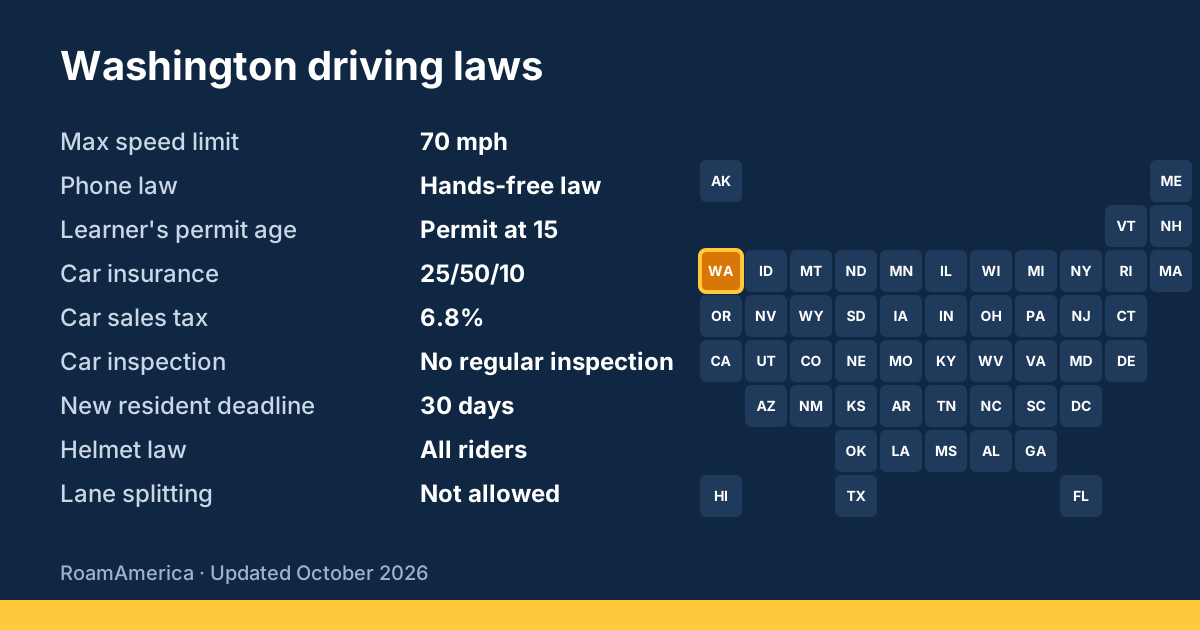
Washington driving laws: speed limits
The maximum speed limit in Washington is 70 mph. Rural interstates reach up to 70 mph and urban freeways at up to 60 mph.
| Washington: Top posted speed | 70 mph |
|---|---|
| Interstates outside cities | 70 mph |
| City freeways | 60 mph |
State law allows up to 75 mph after an engineering study, but 70 mph is the highest limit posted.
On major roads such as I-5 and I-90, posted limits are frequently below 70 mph, especially through Seattle and in work zones.
Every driver must also hold a speed that suits rain, fog and traffic, even when that means going slower, and officers can write a ticket for that alone.
In short, under Washington driving laws: max speed limit, 70 mph.
Washington driving laws: cell phone and texting law
Only hands-free. Washington has a hands-free law: drivers are not permitted to hold a phone to talk, text or browse behind the wheel. Bluetooth calls and mounted navigation remain legal.
| Washington: Hand-held calls | Banned |
|---|---|
| Texting behind the wheel | Banned |
| Teen phone ban | Permit and intermediate license holders |
Under the Washington driving laws, a phone in a mount, a voice assistant and one swipe to answer a call or start navigation are permitted; holding the phone at a stoplight is not.
Young motorists get a stricter law: in Washington, permit and intermediate license holders may not use a phone at all, not even through Bluetooth.
Bottom line, under Washington driving laws: phone law, hands-free law.
Washington driving laws: driving age and teen licenses
Teens in Washington may obtain a learner's permit at 15 and a provisional (intermediate) license at 16, which still restricts night driving and passengers.
| Washington: Earliest permit | Age 15 |
|---|---|
| Provisional license | Age 16 |
| Supervised driving hours | 50 (10 at night) |
| Full privileges | After 12 months licensed or at 18, whichever comes first (minimum 17) |
To qualify for the road test, permit holders in Washington need 50 hours (10 at night) of supervised driving.
In short, under Washington driving laws: learner's permit age, permit at 15.
Washington driving laws: minimum car insurance
Washington sets a minimum of 25/50/10 in liability insurance: $25,000 for one injured person, $50,000 for all injuries in one accident and $10,000 for property damage.
| Washington: Per-person injury coverage | $25,000 |
|---|---|
| Bodily injury per accident | $50,000 |
| Property damage | $10,000 |
| Also mandatory | None |
| Fault system | At-fault |
| Coverage mandatory by law | Yes |
Washington follows the at-fault system, so the at-fault driver pays for the other people's injuries and damage through liability coverage.
The legal minimum seldom pays for a serious crash, because medical bills plus a replacement car may exceed $50,000 quickly.
Many agents suggest at least 100/300/100, since damages above your limits can be taken from your savings.
Bottom line, under Washington driving laws: car insurance, 25/50/10.
Washington driving laws: car sales tax
Washington charges a 6.8% state sales tax + motor vehicle tax on vehicle purchases, and local taxes can raise the total.
| Washington: State rate | 6.8% (sales tax + motor vehicle tax) |
|---|---|
| Local taxes added | Yes, in some areas |
| Trade-in credit | Yes |
| State tax on a $30,000 car | $2,040 |
The 6.5% state sales tax plus a 0.3% motor vehicle sales tax; local taxes bring the total to about 9% to 10.6% in many cities. Since January 2026, an extra 8% luxury tax applies to the part of a vehicle's value above $100,000.
- A $22,700 car in Washington: around $1,544 in state tax
- A $39,050 car in Washington: around $2,655 in state tax
- A $55,000 car in Washington: roughly $3,740 in state tax
A trade-in reduces the Washington driving laws: a $30,000 car with a $5,000 trade-in owes roughly $1,700 compared with $2,040.
In short, under Washington driving laws: car sales tax, 6.8%.
Washington driving laws: car inspection and emissions
No. Washington does not require periodic safety inspections or emissions tests for passenger vehicles.
| Washington: Safety check | Not required |
|---|---|
| Smog check | Not mandatory |
Washington ended emissions testing in 2020.
Since no safety inspection is mandatory in Washington, keeping brakes and tires in good order is your responsibility.
Bottom line, under Washington driving laws: car inspection, no regular inspection.
Washington driving laws: license and registration deadlines for new residents
After moving to Washington, you have 30 days to obtain a Washington driver's license, and 30 days to register your car.
| Washington: License deadline | 30 days |
|---|---|
| Vehicle registration | 30 days |
| Insurance minimum | 25/50/10 |
| Vehicle check | No regular inspection |
Step-by-step list for Washington driving laws
- Get a Washington driver's license: 30 days. Bring proof of identity, your SSN and two documents with your new address to the Washington Department of Licensing (DOL) (REAL ID rules).
- Buy car insurance at or above the minimum: Washington requires 25/50/10. A policy is generally mandatory before registration.
- Inspection: No regular inspection, though a VIN check can be needed for an out-of-state car.
- Title and register the car: 30 days at the car licensing office.
The clock generally begins once you start work, rent a home or register kids for school in Washington, not on the day the truck arrives.
At a glance, under Washington driving laws: new resident deadline, 30 days.
Washington driving laws: motorcycle helmet law
Yes. Washington has a universal helmet law: all motorcyclists and passengers has to wear a DOT-compliant helmet, regardless of age. That holds on I-5 and I-90 as much as on local streets in Seattle.
| Washington: Who must wear a helmet | All riders and passengers |
|---|---|
| Type of law | Universal |
| Adults can ride without a helmet | No |
Under the Washington driving laws, operators and passengers of any age must wear a helmet on any motorcycle, and on mopeds that require an endorsement.
NHTSA estimates that helmets prevent around 37% of rider deaths in serious crashes, and 41% for passengers.
Any helmet worn to meet the law carries the DOT label on the back; thin novelty shells without it are not legal.
Bottom line, under Washington driving laws: helmet law, all motorcyclists.
Washington driving laws: lane splitting
No. Splitting and filtering are illegal in Washington. Motorcycles must use a full lane, and riders cannot squeeze between cars or ride between lanes of traffic.
| Washington: Lane splitting (moving traffic) | Not legal |
|---|---|
| Passing stopped vehicles | Not legal |
| Law dates from | — |
Without a law that allows it, Washington driving laws is treated as an illegal pass or an unsafe lane change, and a collision during a split may count against the rider with insurers.
Bottom line, under Washington driving laws: lane splitting, not permitted.
Where the Washington driving laws stand out
- Washington ranks close to the national average of the national range on all nine topics, so few laws in the Washington driving laws will surprise drivers from other states.
On the roads of Washington
Most long trips use I-5, I-90 and I-405, linking Seattle, Spokane and Olympia. Each of these routes is covered by Washington driving laws.
You get a license from the Washington Department of Licensing (DOL), and registration and titles go through the car licensing office.
All of the Washington driving laws above apply across the state, whether in Seattle or in rural counties.
Next door
- Idaho: max speed limit of 80 mph instead of 70 mph; 6% for car sales tax, against 6.8%; 25/50/15 for car insurance, against 25/50/10
- Oregon: 0.5% for car sales tax, against 6.8%; car insurance of 25/50/20 instead of 25/50/10
FAQ: the Washington driving laws
Do the Washington driving laws change for trucks?
Most roads in Washington post the same number for vehicles and trucks; look for separate truck signs.
Can an officer stop motorists only for breaking the Washington driving laws?
Yes. In Washington it is generally primary enforcement, meaning police can pull you over for it alone.
Can a 15-year-old drive alone under the Washington driving laws laws?
No. Driving without an adult begins after you receive the provisional license at 16 in Washington.
What if I drive without Washington driving laws?
Skipping insurance in Washington may bring penalties, suspension of your license and plates, and personal liability for the damage you cause.
Is the Washington driving laws owed on used vehicles?
Yes. Used vehicles are taxed too, and sales between individuals can be taxed at a minimum or book value.
Is a Washington driving laws required to sell a car?
Usually not in Washington, although a buyer can want one.
Do adults have to obey the Washington driving laws?
Yes. Anyone on the bike in Washington must wear a helmet.
Is moving up at a light part of Washington driving laws?
No. Riding between stopped cars at a light is not permitted in Washington too.
Travel ideas in Washington
- Place to visitOlympic National ParkThree parks in one: glacier peaks, moss-draped rainforest and a wild Pacific coast.
- Place to visitMount Rainier National ParkA glacier-covered volcano above meadows that burst into wildflowers each summer.
- Place to visitSpace NeedleSeattle’s World’s Fair tower from 1962, now with a rotating glass floor high above the city.
- Place to visitPike Place MarketFlying fish, a gum-covered wall and more than a century of farmers and makers above Elliott Bay.
- Place to visitMount St. HelensThe volcano that blew off its top in 1980, and the forest coming back to life around it.
- Hiking trailSkyline Trail at ParadiseA loop through wildflower meadows to a viewpoint face to face with the glaciers of Mount Rainier.