State guide · Updated October 2026
Indiana Driving Laws (2026): Speed Limits, Insurance and More
Indiana belongs to the Midwest region, with Indianapolis as its capital and Indianapolis and Fort Wayne among its largest cities. This page gathers the Indiana driving laws that matter most, from speed limits and phone use through coverage, taxes, inspections and riding.
Each section below covers one rule in detail, with the facts, the figures and how it compares nationally with sources; data was reviewed October 25, 2026.
Indiana driving laws: speed limits
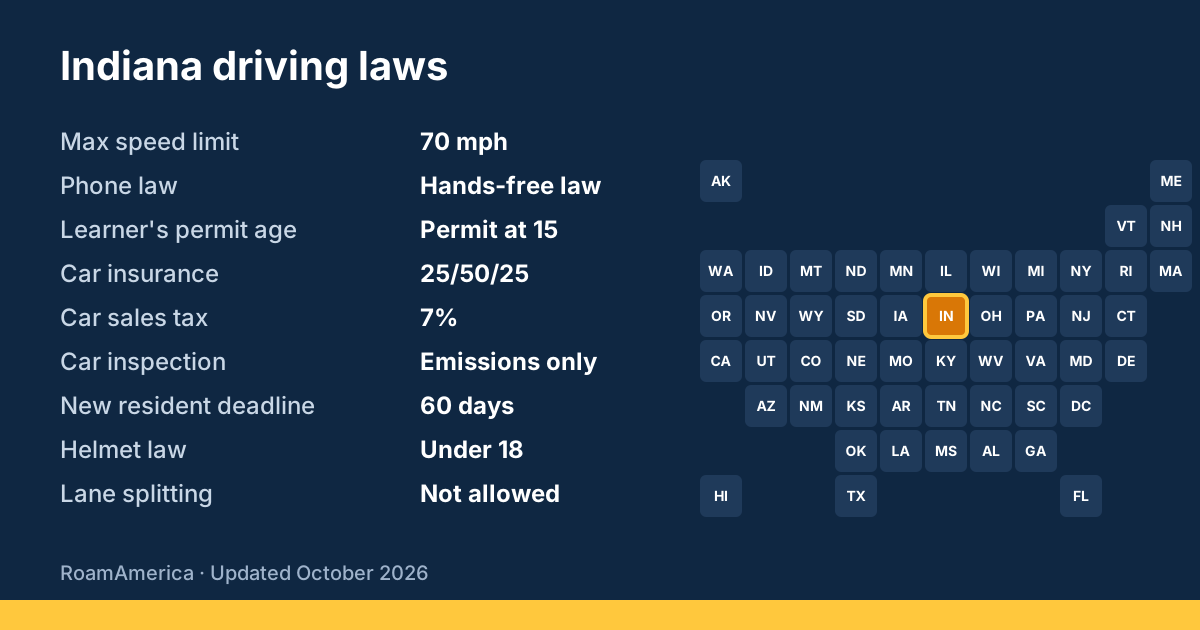
The highest speed limit in Indiana is 70 mph. Rural interstates reach up to 70 mph and urban freeways up to 55 mph.
| Indiana: Top posted speed | 70 mph |
|---|---|
| Rural interstates | 70 mph |
| Urban interstates | 55 mph |
On busy roads such as I-65 and I-70, signs are frequently lower than 70 mph, especially through Indianapolis and in work zones.
Drivers must also keep a speed reasonable for weather and traffic, even under the limit, and officers can write a ticket for that alone.
In short, under Indiana driving laws: max speed limit, 70 mph.
Indiana driving laws: cell phone and texting law
Only hands-free. Indiana enforces a hands-free law: motorists cannot hold a phone to talk, text or browse on the road. Bluetooth calls and mounted navigation remain legal.
| Indiana: Hand-held calls | Banned |
|---|---|
| Texting while driving (all motorists) | Banned |
| Phone ban for new drivers | Drivers under 21 |
Under the Indiana driving laws, a mounted phone, spoken commands and one swipe to pick up a call or start navigation are permitted; picking it up in traffic is the offense.
Young motorists obtain a stricter rule: in Indiana, drivers under 21 are barred from phone use in any way, not even through Bluetooth.
At a glance, under Indiana driving laws: phone law, hands-free law.
Indiana driving laws: driving age and teen licenses
Young motorists in Indiana can get a learner's permit at 15 and a provisional license at 16; limits on night driving and passengers follow.
| Indiana: Learner's permit | Age 15 |
|---|---|
| Intermediate (provisional) license | Age 16 |
| Supervised driving hours | 50 (10 at night) |
| Full privileges | Age 18 |
Prior to the road test, permit holders in Indiana log 50 hours (10 at night) of supervised driving.
In short, under Indiana driving laws: learner's permit age, permit at 15.
Indiana driving laws: minimum car insurance
Indiana requires drivers to carry at least 25/50/25 in liability insurance: $25,000 for one injured person, $50,000 for all injuries in one accident and $25,000 for property damage.
| Indiana: Per-person injury coverage | $25,000 |
|---|---|
| Bodily injury per accident | $50,000 |
| Property damage limit | $25,000 |
| Also mandatory | None |
| At-fault or no-fault | At-fault |
| Coverage mandatory by law | Yes |
Indiana follows the at-fault system, so whoever causes a crash pays for the other people's injuries and damage through liability coverage.
A minimum policy rarely covers a serious crash: treatment and repairs may top $50,000 quickly.
Advisers frequently recommend at least 100/300/100, because costs beyond the policy may be taken from your savings.
At a glance, under Indiana driving laws: car insurance, 25/50/25.
Indiana driving laws: car sales tax
Indiana applies a 7% state sales tax on cars you buy. Cities and counties add nothing.
| Indiana: Statewide rate | 7% (sales tax) |
|---|---|
| Local add-ons | No |
| Trade-in credit | Yes |
| Example: $30,000 car | $2,100 |
- A $19,400 car in Indiana: roughly $1,358 in state tax
- A $34,100 car in Indiana: around $2,387 in state tax
- A $55,000 car in Indiana: roughly $3,850 in state tax
A trade-in cuts the Indiana driving laws: with $5,000 in trade on a $30,000 car, you owe about $1,750 compared with $2,100.
In short, under Indiana driving laws: car sales tax, 7%.
Indiana driving laws: vehicle inspection and emissions
Only an emissions test. Indiana skips safety inspections, but does require emissions testing in Lake and Porter counties (near Chicago).
| Indiana: Safety inspection | Not required |
|---|---|
| Smog check | Some areas: Lake and Porter counties (close to Chicago) |
With no regular safety check in Indiana, keeping brakes, lights and tires in good order is up to the owner.
Emissions tests on newer cars read the on-board computer, which takes a few minutes; a lit check-engine light generally means an automatic fail.
Bottom line, under Indiana driving laws: car inspection, emissions only.
Indiana driving laws: license and registration deadlines for new residents
After moving to Indiana, you have 60 days to obtain a Indiana driver's license, and 60 days to register your car.
| Indiana: New driver's license | 60 days |
|---|---|
| Vehicle registration | 60 days |
| Required insurance | 25/50/25 |
| Vehicle check | Emissions only |
Step-by-step list for Indiana driving laws
- Get a Indiana driver's license: 60 days. Take an ID document, your Social Security number and two proofs of address to the Indiana BMV (REAL ID laws).
- Set up car insurance that meets the minimum: Indiana requires 25/50/25. A policy is generally mandatory before registration.
- Vehicle check: Only an emissions test. Indiana does not require periodic safety checks, but requires emissions testing in Lake and Porter counties (close to Chicago).
- Register and title your car: 60 days at the Indiana BMV.
The clock usually begins once you begin a job, buy a house or put children in a local school in Indiana, not on the day the boxes arrive.
In short, under Indiana driving laws: new resident deadline, 60 days.
Indiana driving laws: motorcycle helmet law
Only for motorcyclists under 18. In Indiana, motorcyclists 17 and younger must wear a helmet; motorcyclists 18 and older can choose to ride without one. It is the same in Indianapolis, in Fort Wayne and on quiet stretches of I-70.
| Indiana: Helmets mandatory for | Riders 17 and younger |
|---|---|
| Kind of law | Partial (age-based) |
| Adult riders exempt | Yes |
Riders 17 and younger must wear a helmet under the Indiana driving laws; from age 18 it becomes optional.
NHTSA estimates that helmets cut roughly 37% of rider deaths in crashes, and around 41% for passengers.
A legal helmet carries the DOT symbol on the back; thin novelty shells without it do not count.
Bottom line, under Indiana driving laws: helmet law, under 18.
Indiana driving laws: lane splitting
No. Splitting and filtering are not legal in Indiana. Motorcycles must use a full lane, and motorcyclists are not permitted to squeeze between vehicles or ride on the lane line.
| Indiana: Splitting in moving traffic | Not legal |
|---|---|
| Passing stopped cars | Not legal |
| In effect since | — |
Without a law that allows it, Indiana driving laws is cited as an illegal pass, and a crash while splitting can undercut the rider in an injury claim.
Bottom line, under Indiana driving laws: lane splitting, not allowed.
Where the Indiana driving laws stand out
- Car sales tax: 7% — among the higher 5 nationwide
On the roads of Indiana
The main routes are I-65, I-70 and I-69, linking Indianapolis, Fort Wayne and Indianapolis. Each of these routes falls under Indiana driving laws.
You get a license from the Indiana BMV, and registration and titles come from the Indiana BMV.
Every rule on this page applies in each county, from Indianapolis to small towns.
Across the border
- Illinois: car sales tax of 6.25% instead of 7%; car insurance of 25/50/20 instead of 25/50/25; No helmet law for helmet law, against Under 18
- Kentucky: car sales tax of 6% instead of 7%; helmet law of Under 21 instead of Under 18
- Michigan: 75 mph for max speed limit, against 70 mph; car sales tax 6% (vs. 7%); 50/100/10 for car insurance, against 25/50/25
- Ohio: 5.75% for car sales tax, against 7%
Questions about the Indiana driving laws
Do the Indiana driving laws change for trucks?
The majority of roads in Indiana use the same number for cars and trucks; look for signs posted just for trucks.
Can an officer stop a driver just for violating the Indiana driving laws?
Yes. In Indiana it is generally a primary offense, so an officer can stop you for it without any other reason.
Can a 15-year-old drive alone under the Indiana driving laws rules?
No. Driving without an adult starts with the provisional license at 16 in Indiana.
What if I drive without Indiana driving laws?
Driving uninsured in Indiana can bring penalties, suspension of your license and plates, and personal responsibility for crash costs.
Is the Indiana driving laws charged on used cars?
Yes. Used cars are taxed too, and sales between individuals may be taxed at a minimum or book value.
Is a Indiana driving laws needed to sell a car?
Not by law in Indiana, although buyers can ask for one.
Does an adult need to follow the Indiana driving laws?
No. Only motorcyclists 17 and younger are covered in Indiana.
Is filtering at red lights part of Indiana driving laws?
No. Squeezing between stopped cars at a light is illegal in Indiana as well.