State guide · Updated October 2026
Illinois Driving Laws (2026): Speed, Phone, Insurance, Tax
Illinois belongs to the Midwest region, with Springfield as the capital and Chicago and Aurora as its biggest cities. This page gathers the Illinois driving laws that matter most, covering speed limits and phone use to insurance, car tax and motorcycles.
Each section below answers one question in detail, with the facts, the numbers and how it compares nationally; we last verified the numbers on October 25, 2026 for Illinois.
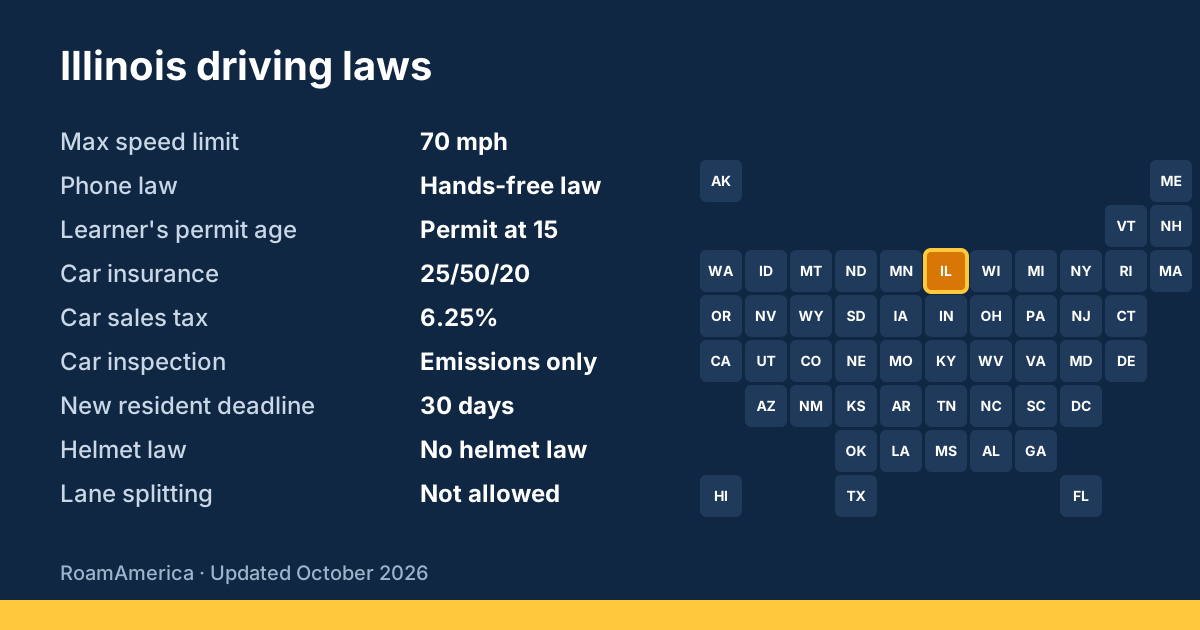
Illinois driving laws: speed limits
The maximum speed limit in Illinois is 70 mph. Rural interstates reach up to 70 mph and urban interstates up to 55 mph.
| Illinois: Top posted speed | 70 mph |
|---|---|
| Interstates outside cities | 70 mph |
| City freeways | 55 mph |
On major roads such as I-90 and I-55, posted limits are frequently lower than 70 mph, especially around Chicago and in work zones.
Motorists also need to keep a speed that is safe for rain, fog and traffic, even under the limit, and officers can write a ticket for that alone.
At a glance, under Illinois driving laws: max speed limit, 70 mph.
Illinois driving laws: cell phone and texting law
Only hands-free. Illinois has a hands-free law: motorists cannot hold a phone to call, text or scroll on the road. Bluetooth calls and mounted navigation remain legal.
| Illinois: Hand-held calls | Banned |
|---|---|
| Texting behind the wheel | Banned |
| Phone ban for new motorists | Permit and intermediate license holders under 19 |
Under the Illinois driving laws, a dash-mounted phone, spoken commands and one swipe to answer a call or begin a route are permitted; holding the phone at a stoplight is not.
Teen drivers face more: in Illinois, permit and intermediate license holders under 19 are barred from phone use while driving, not even through Bluetooth.
At a glance, under Illinois driving laws: phone law, hands-free law.
Illinois driving laws: driving age and teen licenses
In Illinois, teens can obtain a learner's permit at 15 and a provisional license at 16; limits on night driving and passengers obey.
| Illinois: Earliest permit | Age 15 |
|---|---|
| Second-stage license | Age 16 |
| Supervised driving hours | 50 (10 at night) |
| All limits lifted | Age 18 |
To qualify for the road test, new drivers in Illinois must log 50 hours (10 at night) of supervised driving.
At a glance, under Illinois driving laws: learner's permit age, permit at 15.
Illinois driving laws: minimum car insurance
Illinois sets a minimum of 25/50/20 in liability insurance: $25,000 for one injured person, $50,000 for all injuries in one accident and $20,000 for property damage. Policies must also include uninsured motorist (UM) coverage and underinsured motorist (UIM) coverage.
| Illinois: Injury limit per person | $25,000 |
|---|---|
| Per-accident injury coverage | $50,000 |
| Property damage limit | $20,000 |
| Other mandatory coverage | UM, UIM |
| At-fault or no-fault | At-fault |
| Insurance mandatory | Yes |
Illinois is an at-fault state, so the at-fault driver pays for the other people's injuries and damage through liability coverage.
Required on top of liability in Illinois: uninsured motorist (UM) coverage and underinsured motorist (UIM) coverage.
Bare-minimum coverage rarely covers a serious crash, since treatment and repairs may exceed $50,000 fast.
Many agents suggest limits like 100/300/100, because damages above your limits may be collected from you directly.
At a glance, under Illinois driving laws: car insurance, 25/50/20.
Illinois driving laws: car sales tax
Illinois applies a 6.25% state sales tax on cars you buy, and local taxes can raise the total.
| Illinois: State rate | 6.25% (sales tax) |
|---|---|
| Local taxes added | Yes, in some areas |
| Trade-in lowers tax | Yes |
| Tax on a $30,000 purchase | $1,875 |
Dealer sales pay 6.25% plus local taxes. Private-party sales pay a separate vehicle use tax based on the price and the vehicle's age.
- A $19,300 car in Illinois: roughly $1,206 in state tax
- A $33,950 car in Illinois: roughly $2,122 in state tax
- A $55,000 car in Illinois: roughly $3,438 in state tax
A trade-in lowers the Illinois driving laws: a $30,000 car with a $5,000 trade-in owes roughly $1,563 rather than $1,875.
In short, under Illinois driving laws: car sales tax, 6.25%.
Illinois driving laws: car inspection and emissions
Only an emissions test. Illinois does not require periodic safety checks, but does require emissions testing in the Chicago and Metro East (St. Louis) areas.
| Illinois: Safety inspection | Not required |
|---|---|
| Emissions testing | Some areas: the Chicago and Metro East (St. Louis) areas |
Since no safety inspection is required in Illinois, maintaining brakes and tires in good order is up to the owner.
Emissions tests on newer vehicles read the on-board computer, which takes a few minutes; a lit check-engine light generally means a failure.
Bottom line, under Illinois driving laws: car inspection, emissions only.
Illinois driving laws: license and registration deadlines for newcomers
After moving to Illinois, you have 90 days to obtain a Illinois driver's license, and 30 days to register your car.
| Illinois: Switch your license | 90 days |
|---|---|
| Plate deadline | 30 days |
| Minimum car insurance | 25/50/20 |
| Inspection | Emissions only |
Checklist for Illinois driving laws
- Apply for a Illinois driver's license: 90 days. Bring an ID document, your SSN and two proofs of address to the Illinois Secretary of State; REAL ID rules apply.
- Buy car insurance at or above the minimum: Illinois sets a floor of 25/50/20. A policy is generally needed before registration.
- Inspection: Only an emissions test. Illinois skips safety inspections, but requires emissions testing in the Chicago and Metro East (St. Louis) areas.
- Register and title your car: 30 days at the Illinois Secretary of State.
The clock generally starts once you start work, sign a lease or put children in a local school in Illinois, not on the day the truck arrives.
In short, under Illinois driving laws: new resident deadline, 30 days.
Illinois driving laws: motorcycle helmet law
No. Illinois is one of only three states, together with Iowa and New Hampshire, that have no motorcycle helmet requirement for motorcyclists of any age. Whether you are on I-90 near Chicago or on I-57, the rule does not change.
| Illinois: Who must wear a helmet | No one |
|---|---|
| Law type | None |
| Adults may ride without a helmet | Yes |
No rider has to wear a helmet under the Illinois driving laws, including passengers or motorcyclists on a learner's permit.
NHTSA estimates that helmets cut over a third of rider deaths in serious crashes, and around 41% of passenger deaths.
A compliant helmet indicates the DOT symbol on the back; novelty helmets that lack it are not legal.
At a glance, under Illinois driving laws: helmet law, no helmet law.
Illinois driving laws: lane splitting
No. Riding between lanes are illegal in Illinois. Motorcycles must use a full lane, and motorcyclists cannot ride between vehicles or ride on the lane line.
| Illinois: Riding between moving lanes | Not legal |
|---|---|
| Lane filtering (stopped traffic) | Not legal |
| In effect since | — |
Because no statute permits it, Illinois driving laws is treated as an illegal pass, and a collision during a split may hurt the rider with insurers.
In short, under Illinois driving laws: lane splitting, not allowed.
Where the Illinois driving laws stand out
- No helmet law (helmet law) — in the looser group of 3 nationwide
On the roads of Illinois
Key highways include I-90, I-55 and I-57, which tie together Chicago, Aurora and Springfield, the capital. Every one of these roads is covered by Illinois driving laws.
You get a license from the Illinois Secretary of State, and plates and titles go through the Illinois Secretary of State.
Every rule on this page applies across the state, from Chicago to small towns.
Across the border
- Indiana: car sales tax 7% (vs. 6.25%); car insurance of 25/50/25 instead of 25/50/20; helmet law of Under 18 instead of No helmet law
- Iowa: car sales tax 5% (vs. 6.25%); car insurance of 20/40/15 instead of 25/50/20
- Kentucky: 6% for car sales tax, against 6.25%; car insurance 25/50/25 (vs. 25/50/20); helmet law of Under 21 instead of No helmet law
- Missouri: 75 mph for max speed limit, against 70 mph; car sales tax 4.225% (vs. 6.25%); car insurance of 25/50/25 instead of 25/50/20
- Wisconsin: car sales tax of 5% instead of 6.25%; car insurance of 25/50/10 instead of 25/50/20; helmet law Under 18 (vs. No helmet law)
FAQ: the Illinois driving laws
Do the Illinois driving laws change for trucks?
Nearly all roads in Illinois post the same limit for cars and trucks; watch for separate truck signs.
Will police pull over a driver only for breaking the Illinois driving laws?
Yes. In Illinois it is generally a primary offense, so an officer can stop you for it alone.
May a 15-year-old drive unsupervised under the Illinois driving laws rules?
No. Driving alone starts with the provisional license at 16 in Illinois.
What happens if I drive without Illinois driving laws?
Driving without coverage in Illinois can bring fines, loss of your registration, and personal liability for crash costs.
Is the Illinois driving laws charged on used cars?
Yes. A used car is taxed the same way, and sales between individuals may be valued at a minimum or book value.
Is a Illinois driving laws needed to sell a car?
Generally not in Illinois, although buyers can ask for one.
Do adults have to follow the Illinois driving laws?
No. Illinois has no helmet requirement for any rider.
Is filtering at a stoplight part of Illinois driving laws?
No. Moving between stopped vehicles at a light is not permitted in Illinois either.
Travel ideas in Illinois
- Place to visitChicagoThe city that invented the skyscraper, best seen from a boat on its river.
- Place to visitArt Institute of ChicagoSeurat, Hopper, Van Gogh and American Gothic, behind two bronze lions on Michigan Avenue.
- Place to visitWillis Tower SkydeckStep out onto a glass box 412 meters above the streets of Chicago, with views over four states.
- Place to visitMillennium ParkThe Bean reflects the skyline, giant faces spout water and free concerts fill a Frank Gehry stage.
- Place to visitField MuseumMeet SUE, the most complete Tyrannosaurus rex ever found, on Chicago’s lakefront.
- RV road tripRoute 66The Mother Road turns 100 in 2026: neon motels, diners and 2,448 miles of Americana.