State comparison · Updated October 2026
Georgia vs. North Carolina Driving Laws (2026)
Georgia and North Carolina differ on 5 of 9 topics we track: phone law, car insurance, car sales tax, car inspection and new resident deadline.
Heading from Atlanta to Charlotte takes you across the border, and 5 of these rules differ once you cross. Main routes include I-75 on the Georgia side and I-40 in North Carolina; the capitals, Atlanta and Raleigh, set the laws for their side.
The largest difference: minimum coverage differs: 25/50/25 versus 50/100/50. People who live in Columbus heading to Raleigh, and back, follow both rulebooks: Georgia's on I-85 and North Carolina's following the state line on I-85. Use the Georgia vs North Carolina guide if you shop for a car between Atlanta and Charlotte.
For a weekend trip from Atlanta to Raleigh, pack your documents and proof of insurance, set navigation before leaving, and look for the same 70 mph top limit at the line.
| Topic | Georgia | North Carolina |
|---|---|---|
| Max speed limit | 70 mph | 70 mph |
| Phone law | Hands-free law | Texting ban only |
| Learner's permit age | Permit at 15 | Permit at 15 |
| Car insurance | 25/50/25 | 50/100/50 |
| Car sales tax | 7% | 3% |
| Car inspection | Emissions only | Safety + emissions |
| New resident deadline | 30 days | 60 days |
| Helmet law | All riders | All riders |
| Lane splitting | Not allowed | Not allowed |
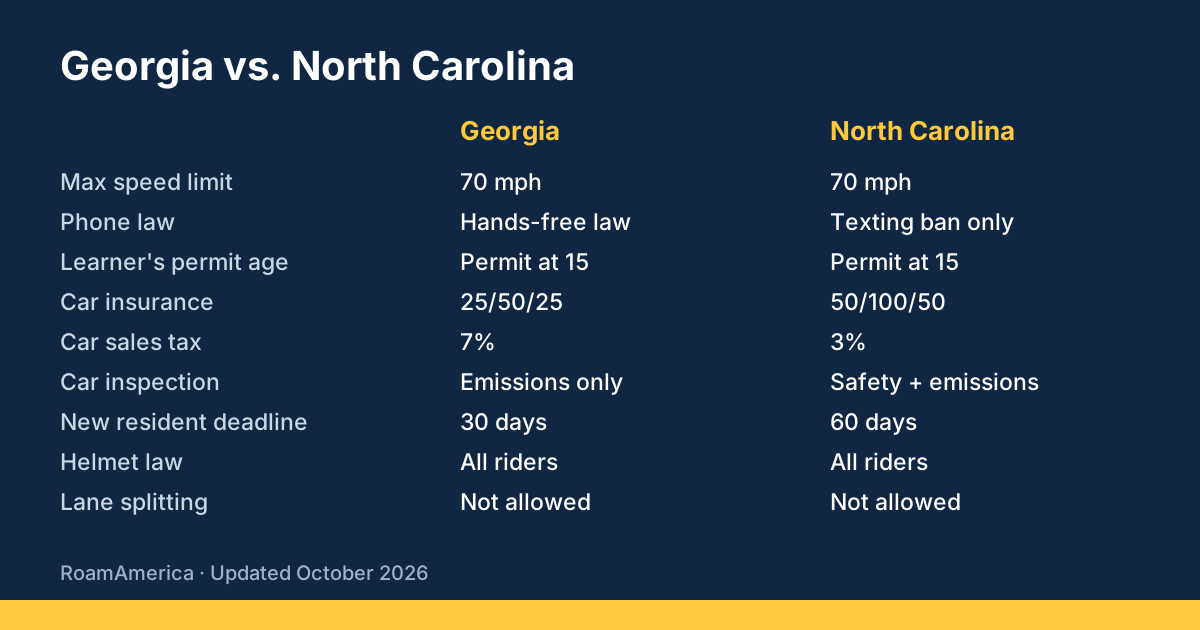
Driving laws: Georgia vs North Carolina
Georgia vs North Carolina: Georgia and North Carolina have the same law for max speed limit (70 mph) and Permit at 15 for learner's permit age.
Cell phone and texting laws: Georgia vs North Carolina
Georgia is stricter on phone law, with Georgia with hands-free law and North Carolina with texting ban only. Phone use that is fine near Atlanta may not be close to Charlotte.
Owning a car: Georgia vs North Carolina
Minimum car insurance requirements: Georgia vs North Carolina
North Carolina is higher on car insurance: Georgia at 25/50/25 and North Carolina at 50/100/50. Georgia is at-fault while North Carolina is at-fault. An insurance policy from Atlanta has to be switched if you relocate to Charlotte.
Car sales tax: Georgia vs North Carolina
North Carolina is lower on car sales tax, with Georgia at 7% and North Carolina at 3%. For a $30,000 purchase, state tax comes to roughly $2,100 in Georgia and $900 in North Carolina. Buyers from Columbus or Raleigh owe the tax based on their registration address.
Vehicle inspection and emissions testing: Georgia vs North Carolina
Georgia is lighter on car inspection, with Georgia with emissions only and North Carolina at safety + emissions. A car registered in Columbus answers to Georgia rules, even on trips to Raleigh.
Moving deadlines: Georgia vs North Carolina
Georgia is shorter on new resident deadline, with Georgia at 30 days and North Carolina at 60 days. Families moving from Columbus into Raleigh should book DMV visits early.
Motorcycle compared: Georgia vs North Carolina
Georgia vs North Carolina: North Carolina and Georgia match on helmet law (All motorcyclists) and lane splitting: Not permitted.
Moving or buying across the border
- Georgia vs North Carolina: relocating from Georgia to North Carolina means 60 days to register the car and 60 days for a license.
- The other way: 30 days for registration and 30 days for a license.
Georgia vs North Carolina: common questions
Where may you drive faster, Georgia or North Carolina?
Both Georgia and North Carolina top out at 70 mph.
Which state taxes vehicles less — Georgia or North Carolina?
North Carolina charges less at the state level (7% vs. 3%).
Do I need a helmet in both Georgia and North Carolina?
Georgia: All riders; North Carolina: All riders.