State comparison · Updated October 2026
Connecticut vs. Massachusetts Driving Laws (2026)
Connecticut and Massachusetts part ways on 4 of 9 topics we track: car insurance, car sales tax, car inspection and helmet law.
On a trip from Bridgeport to Boston takes you across the border, and 4 of the laws differ once you cross. Key roads are I-95 on the Connecticut side and I-90 in Massachusetts; the capitals, Hartford and Boston, set the laws for each side.
What changes most: mandatory liability limits differ: 25/50/25 versus 25/50/30. People who live in Stamford who travel to Worcester, or vice versa, follow both rulebooks: Connecticut's on I-84 and Massachusetts's after the border on I-93. Read the Connecticut vs Massachusetts guide before driving from Bridgeport and Boston.
For a weekend trip from Hartford to Boston, keep your documents if you ride, set navigation ahead of time, and expect the same 65 mph top limit at the line.
| Topic | Connecticut | Massachusetts |
|---|---|---|
| Max speed limit | 65 mph | 65 mph |
| Phone law | Hands-free law | Hands-free law |
| Learner's permit age | Permit at 16 | Permit at 16 |
| Car insurance | 25/50/25 | 25/50/30 |
| Car sales tax | 6.35% | 6.25% |
| Car inspection | Emissions only | Safety + emissions |
| New resident deadline | 30 days | 30 days |
| Helmet law | Under 21 | All riders |
| Lane splitting | Not allowed | Not allowed |
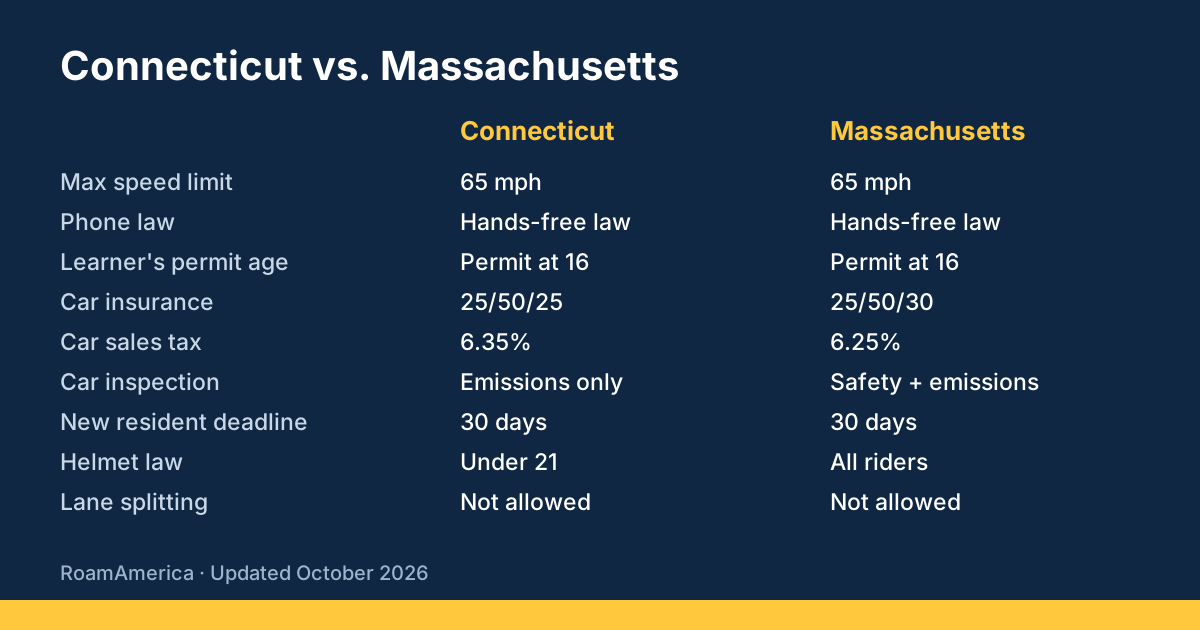
Driving laws compared: Connecticut vs Massachusetts
Connecticut vs Massachusetts: Connecticut and Massachusetts agree on max speed limit (65 mph), Hands-free law for phone law and Permit at 16 for learner's permit age.
Owning a car compared: the comparison
Connecticut vs Massachusetts: Connecticut and Massachusetts have the same law for new resident deadline (30 days).
Car insurance: Connecticut vs Massachusetts
The rule is higher in Massachusetts on car insurance: Connecticut with 25/50/25 and Massachusetts at 25/50/30. Connecticut is at-fault while Massachusetts is no-fault. A policy written in Bridgeport needs to be rewritten when you settle in Boston.
Car sales tax: Connecticut vs Massachusetts
The rule is higher in Connecticut on car sales tax, with Connecticut with 6.35% and Massachusetts at 6.25%. On a $30,000 car, state tax is roughly $1,905 in Connecticut versus $1,875 in Massachusetts. Shoppers in Stamford and Worcester pay car tax where the car is registered, not the dealer's.
Vehicle inspection and emissions testing: Connecticut vs Massachusetts
The law is stricter in Massachusetts on car inspection, with Connecticut at emissions only and Massachusetts at safety + emissions. Owners in Stamford is inspected under Connecticut laws, even when driven to Worcester.
Motorcycle compared: Connecticut vs Massachusetts
Connecticut vs Massachusetts: Massachusetts and Connecticut have the same rule for Not allowed for lane splitting.
Helmet law: Connecticut vs Massachusetts
Massachusetts is stricter on helmet law, with Connecticut at under 21 and Massachusetts at all riders. Motorcyclists riding from Bridgeport toward Boston switch to Massachusetts's helmet rule on arrival.
Moving or buying across the border
- Connecticut vs Massachusetts: moving from Connecticut to Massachusetts gives you 30 days to register the car and 30 days for the license switch.
- Going from Massachusetts to Connecticut: 60 days to register and 30 days to switch licenses.
Connecticut vs Massachusetts: questions
Where can you drive faster, Connecticut or Massachusetts?
Both Connecticut and Massachusetts top out at 65 mph.
Which state taxes vehicles less — Connecticut or Massachusetts?
Massachusetts charges less at the state level (6.35% vs. 6.25%).
Is a motorcycle helmet mandatory in both Connecticut and Massachusetts?
Connecticut: Under 21; Massachusetts: All motorcyclists.